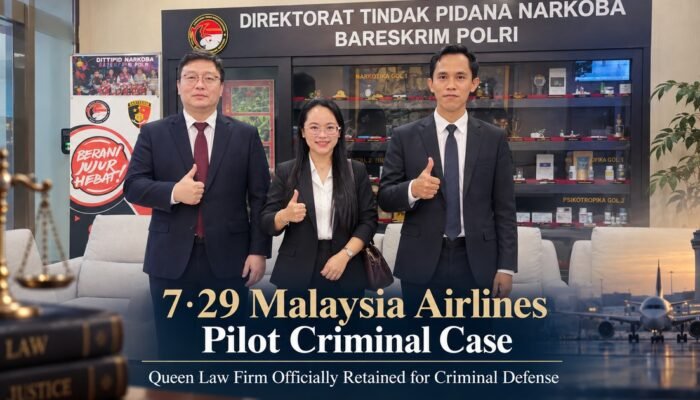
Our Legal Team Represents a Chinese National in an Indonesian Wildlife Protection Case Entering the Prosecution Stage

Case Update

According to publicly available information released by Gakkum Kehutanan, a criminal case involving a Chinese national in relation to alleged violations of Indonesian wildlife protection laws has completed the investigation stage and has been transferred to the Public Prosecutor’s Office for prosecution.

Based on the official information disclosed, the matter originated from an inspection conducted by law enforcement authorities at Soekarno–Hatta International Airport. Following the completion of the investigative process, the case has now proceeded to the prosecution stage.

Our legal team has been formally retained by the client and the client’s family and is currently providing legal representation throughout the ongoing criminal proceedings.

Ongoing Legal Representation

The matter is presently under review by the Public Prosecutor’s Office. Our legal team continues to assist the client through legal analysis, review of evidence, submission of legal opinions, and preparation for potential court proceedings.

Under Indonesian criminal procedural law, the transfer of a case to the prosecution stage does not constitute a determination of guilt. The assessment of facts, admissibility of evidence, and criminal liability remains subject to adjudication by the competent court through due judicial process.

We remain committed to safeguarding our client’s legal rights and ensuring full compliance with the principles of due process and fair trial.

Cross-Border Criminal Matters

As international investment, trade, tourism, and mobility continue to expand in Indonesia, legal issues involving foreign nationals have become increasingly complex.

Cases involving foreign nationals often require consideration of:

  • Cross-border legal and regulatory issues;
  • Differences between legal systems and procedural frameworks;
  • Coordination with family members, consular authorities, and other stakeholders;
  • Strategic defense planning at investigation, prosecution, and trial stages;
  • Effective communication across multiple languages and jurisdictions.

Our Practice Areas

Our firm regularly advises and represents foreign individuals and businesses in Indonesia, including matters involving:

  • Criminal defense and litigation;
  • Representation of foreign nationals in criminal proceedings;
  • Regulatory compliance and risk management;
  • Internal investigations and crisis response;
  • International dispute resolution;
  • Consular coordination and family assistance.

Source of Information

The procedural developments described in this article are based on information publicly released by:

Official Press Release of Gakkum Kehutanan

Disclaimer

This article is intended solely to provide information regarding procedural developments in the case and does not constitute any determination regarding the facts, merits, or legal liability of any party.

Any findings of fact or criminal responsibility remain exclusively within the jurisdiction of the competent court and are subject to a final and binding judgment.

Ignorance That Must Be Proven: A Defense in Psychotropic Cases

There is one statement that frequently arises when a person is apprehended while carrying an item containing psychotropic substances:

“I did not know.”

That statement may be true.

It may also be untrue.

The problem is that, in psychotropic cases, the law is not satisfied merely by hearing the words “I did not know.” The law will inquire further:

If you did not know, why was the item in your possession?

Who gave it to you?

When did you receive it?

What were you told about its contents?

Did you open the suitcase or package?

Were you paid?

Who arranged the trip?

Who was supposed to receive the item at the destination?

Questions such as these often surprise ordinary people. From the perspective of a potential victim, he or she may feel that they were merely helping someone transport an item. From the perspective of law enforcement authorities, however, the prohibited substance was found in that person’s possession or under that person’s control during the journey.

This is where the real issue lies.

In psychotropic cases, ignorance is not something that can merely be stated.

Ignorance must be explained and proven.

I. A Common Story: Carrying a Package for Someone Else, Then Being Arrested

Imagine a person traveling from Milan to Hong Kong, with a transit stop in Indonesia.

Before departure, an acquaintance asks the traveler to carry a suitcase. The traveler is told that it contains clothing, personal belongings, or items intended for family members.

The traveler believes the explanation.

The traveler does not open the suitcase.

The traveler does not believe that any crime is being committed.

The traveler simply thinks he or she is helping someone.

However, during transit in Indonesia, the suitcase is inspected. Law enforcement officers discover psychotropic substances inside. In an instant, what began as an ordinary journey becomes a serious criminal matter.

The traveler panics and says:

“I did not know.”

“The suitcase is not mine.”

“I was only carrying it for someone else.”

From a human perspective, such panic is understandable. In legal proceedings, however, those statements alone are not sufficient.

Law enforcement authorities are still required to investigate. The police must continue gathering facts. Prosecutors must assess the case file. Ultimately, the court will determine whether the claim of ignorance is reasonable, consistent, and supported by evidence.

Accordingly, the key question is no longer merely:

“Did the person carry the item?”

Rather, the questions become:

“Did the person know what the item contained?”

“Was the person aware that he or she was transporting psychotropic substances?”

“Was the person part of a criminal network?”

“Or was the person a victim who had been exploited by others?”

This distinction is critically important. Not every person found carrying prohibited substances is automatically a trafficker, dealer, or courier acting with full knowledge of what they were transporting.

II. Why Does “I Did Not Know” Not Automatically Exonerate Someone?

In criminal cases, particularly psychotropic cases, law enforcement authorities generally begin with the facts that can be objectively observed.

For example:

the prohibited substance is found inside a person’s suitcase;

the baggage tag is registered under that person’s name;

the person is engaged in international travel;

the substance is discovered when the person enters or transits through Indonesia;

and the true owner of the substance has not yet been identified.

Based on such preliminary facts, the individual may still be questioned, detained, or even designated as a suspect, despite claiming that he or she had no knowledge of the contents.

This does not mean that everyone is automatically presumed guilty. Rather, the explanation “I did not know” is also frequently used by individuals who knowingly transport prohibited substances. As a result, law enforcement authorities cannot simply stop their inquiry at the point of such a statement.

For a person who genuinely lacked knowledge, the challenge lies in presenting a credible explanation.

For example:

who provided the suitcase;

what relationship existed between the parties;

what information was given regarding the contents of the suitcase;

whether there are chat records or written communications;

who purchased the airline ticket;

whether any money was provided;

whether the person knew the suitcase combination or access code;

whether the suitcase had ever been opened;

and whether the person immediately identified the individual who entrusted the suitcase to him or her from the outset.

The clearer the answers to these questions, the stronger the defense position becomes.

Conversely, if the answers change over time, lack consistency, or are unsupported by evidence, the defense becomes significantly weaker.

III. Innocent People Often Say the Wrong Things When They Panic

One of the greatest challenges in cases of this nature is that innocent individuals often panic during the initial examination.

They are afraid.

They are confused.

They may not understand the language being used.

They may not be aware of their legal rights.

They may not understand the legal consequences of the answers they provide.

For example, an officer may ask:

“Is this your suitcase?”

The individual responds:

“Yes.”

What the person actually means is that the suitcase was being carried during the journey. It does not necessarily mean that the suitcase belongs to him or her. The suitcase may simply have been entrusted to that person by someone else.

Or an officer may ask:

“Do you know what is inside?”

The individual responds:

“I was told it contained clothing.”

If not properly explained, such an answer can create problems. It may appear as though the person had knowledge of the contents of the suitcase, when in reality he or she was merely repeating information provided by the individual who entrusted the suitcase.

For this reason, initial statements are extremely important in psychotropic cases.

A clearer and safer response may be:

“I was carrying the suitcase, but it does not belong to me. I received it from a person named X. I was only informed that it contained clothing or personal belongings. I was never informed, nor did I know, that the suitcase contained psychotropic substances.”

Such a statement is more complete. It does not deny the fact that the suitcase was being carried, while at the same time explaining that the suitcase belonged to another person and that the contents were unknown to the carrier.

In criminal proceedings, the truth must be communicated accurately.

Not for the purpose of creating a story, but to ensure that the facts are not misunderstood.

IV. Evidence That Should Be Collected Immediately

Many families assume that evidence in a case like this must always be complicated.

In reality, that is not necessarily the case.

Many important pieces of evidence are often already in the possession of the individual involved or his or her family.

For example:

WhatsApp, Telegram, WeChat, Line, SMS, email, or social media communications with the person who entrusted the item;

telephone call records;

airline tickets;

boarding passes;

baggage tags;

proof of ticket payment;

records of money transfers;

hotel booking confirmations;

photographs of the suitcase or the items before departure;

the name and telephone number of the person who provided the item;

the name and telephone number of the person intended to receive the item at the destination country;

messages indicating that the item contained clothing, medicine, supplements, gifts, documents, or personal belongings;

and statements from family members or friends who knew that the individual was merely carrying an item on behalf of someone else.

Evidence of this nature may appear simple.

However, in psychotropic cases, simple evidence can be extremely important.

For example, there may be a message stating:

“Please help bring this suitcase. It contains clothing.”

Such a message does not automatically result in acquittal.

However, it may help demonstrate that the individual was informed that the suitcase contained clothing rather than psychotropic substances.

Similarly, there may be evidence showing that the airline ticket was purchased by another person. This may indicate that the journey was arranged by someone else. Nevertheless, such evidence must be explained carefully.

Otherwise, it may be interpreted as payment for acting as a courier.

For that reason, evidence should not merely be collected.

Evidence must be organized, examined, and explained within a proper defense framework.

What must never be done is deleting messages, editing conversations, fabricating evidence, or inventing new facts.

A single falsehood can undermine many genuine facts that might otherwise assist the defense.

V. Families Should Not Panic, But They Must Act Quickly

When a family learns that one of its members has been arrested in connection with a psychotropic case, panic is often the first reaction.

That reaction is understandable.

However, after the initial panic, the family must act promptly and systematically.

The following steps should be taken:

preserve all communications between the individual and the person who entrusted the item;

record the names, telephone numbers, social media accounts, addresses, and other identifying information of relevant individuals;

retain airline tickets, hotel reservations, transfer records, and travel itineraries;

determine who paid for the airline ticket;

identify anyone who was aware of the trip;

prepare a simple chronology based on the available information;

and seek legal assistance immediately.

Families should also proceed with caution.

Do not make accusations on social media.

Do not contact individuals suspected of setting up or deceiving the person involved without proper legal guidance.

Do not trust individuals who claim that the matter can be resolved through unofficial means.

Psychotropic cases are serious criminal matters.

The safest course is a well-structured legal defense, not vague promises of informal solutions.

VI. A Defense Must Begin at the Earliest Stage, Not After the Case Reaches Trial

One of the most common mistakes is waiting until the case has progressed significantly through the police investigation stage, or even until the case is about to be transferred to the prosecution authorities, before seeking legal counsel.

In psychotropic cases, however, the most serious damage often occurs at the very beginning.

The individual may have already signed an examination report without fully understanding its contents.

The individual may have provided incomplete statements.

The individual may have failed to immediately identify the person who entrusted the item.

The individual may not have requested an interpreter despite not understanding the language used during questioning.

The family may have failed to secure digital evidence in time.

The person who entrusted the item may have disappeared.

Telephone numbers may no longer be active.

Social media accounts may have been deleted.

For these reasons, legal assistance from the earliest stage is critically important.

Legal representation is not intended to teach someone how to lie.

It is not intended to create a story.

It is not intended to avoid the law.

Legal representation is necessary to ensure that a person who is genuinely a victim can explain the events accurately, coherently, consistently, and without unintentionally harming his or her own legal position.

VII. The Defense Theory That Must Be Established

Legal Opinion and Compliance Analysis on Indonesian Companies Providing Guarantees for Overseas Projects of Foreign Affiliates

In cross-border financing and project investment structures, it is common for lenders or investors to require multi-layered credit support. Among these, it has become increasingly common for an Indonesian company to provide a guarantee for a foreign affiliate in respect of an overseas project.

Unlike ordinary commercial guarantees, such arrangements involve multiple legal dimensions, including corporate authority, regulatory compliance, and enforceability. In practice, financial institutions typically require an Indonesian Legal Opinion to confirm the legality, validity, and enforceability of such guarantees.

Queen Law Firm has extensive experience in cross-border transactions of this nature and is able to advise on transaction structuring at an early stage, as well as issue practical and bankable legal opinions under Indonesian law. Set out below is an overview of the key legal considerations and opinion framework.

I. Transaction Structure and Legal Characterization

A typical structure includes:

  1. An offshore entity (usually a parent company or financing vehicle) acting as borrower;
  2. Financing proceeds used for overseas projects or regional investments;
  3. An Indonesian company acting as guarantor, providing a corporate guarantee and/or security over its assets.

The key legal characteristics of such structure are:

  1. The guarantee obligation is assumed by an Indonesian entity, while the financing and project are located offshore;
  2. The benefit to the Indonesian guarantor is often indirect;
  3. Lenders rely heavily on legal opinions to validate enforceability.

Accordingly, the critical issue is not merely the form of the guarantee, but whether it is legally sustainable and enforceable under Indonesian law.

II. Types of Guarantees under Indonesian Law

Indonesian law does not provide a unified regime for cross-border guarantees. Instead, different legal concepts apply depending on the structure.

(i) Personal Guarantee (Borgtocht)

Under Article 1820 of the Indonesian Civil Code (KUHPerdata), a guarantee is an accessory obligation with the following characteristics:

  1. It is dependent on the validity of the principal obligation;
  2. It may be supplementary in nature;
  3. Certain defenses may be contractually waived.

In cross-border financing, lenders typically require waivers of defenses to approximate primary liability.

(ii) Corporate Guarantee

A corporate guarantee is based on the principle of freedom of contract. Its enforceability primarily depends on the legality of the corporate act rather than its classification under civil law.

Key requirements include:

  1. The company has the capacity and authority to enter into the guarantee;
  2. The guarantee complies with the corporate benefit principle;
  3. Internal approvals have been duly obtained.

(iii) Security over Assets (In Rem Security)

Where assets are involved, the following may apply:

  1. Fiduciary security (fidusia) over movable assets;
  2. Mortgage (hak tanggungan) over immovable property;
  3. Pledge (gadai).

Such security interests generally require registration and provide priority rights upon enforcement.

III. Corporate Law Considerations: Corporate Benefit and Authority

(i) Corporate Benefit

Under Indonesian Company Law (Law No. 40 of 2007), directors must act in the best interest of the company.

In the context of guarantees for overseas projects, it is essential to establish:

  1. Whether the financing directly or indirectly benefits the Indonesian company;
  2. Whether the company derives value from group-level financing arrangements;
  3. Whether a guarantee fee or other consideration is provided;
  4. Whether there is operational dependency between the entities.

Failure to demonstrate corporate benefit may result in the guarantee being challenged as an ultra vires act.

(ii) Corporate Approvals

The following approvals are typically required:

  1. Board of Directors approval;
  2. Shareholders’ approval, where required (e.g., material transactions or as stipulated in the Articles of Association);
  3. Proper authorization of signatories.

The completeness of corporate approvals is a key factor in determining enforceability.

(iii) Directors’ Duties

Directors are subject to fiduciary duties, including duties of care and loyalty. Failure to properly assess risks or comply with procedures may expose directors to liability.

IV. Related Party Transaction Considerations

Where the beneficiary of the guarantee is an affiliated party (pihak afiliasi), additional scrutiny applies:

  1. Whether there is a conflict of interest;
  2. Whether the terms are commercially reasonable;
  3. Whether additional approvals or disclosures are required;
  4. Whether an independent fairness opinion is necessary.

These factors are often reviewed during financing due diligence and audits.

V. Foreign Exchange and Regulatory Compliance

(i) External Debt Reporting

Where the guarantee relates to offshore borrowing, the Indonesian company may be required to:

  1. Register the transaction with Bank Indonesia;
  2. Submit periodic reports.

(ii) Prudential Requirements

Certain transactions may be subject to:

  1. Hedging requirements;
  2. Liquidity ratios;
  3. Credit rating considerations.

Although a guarantee is contingent in nature, it may still impact regulatory assessment.

VI. Enforcement and Practical Considerations

(i) Governing Law and Enforcement

Guarantee documents are often governed by foreign law. However:

  1. Indonesian courts do not automatically recognize foreign court judgments;
  2. Enforcement in Indonesia generally requires local proceedings or reliance on arbitration awards.

(ii) Scope of Legal Opinion on Enforceability

In practice, an Indonesian legal opinion will:

  1. Confirm validity and binding nature under Indonesian law;
  2. Provide qualified statements on enforceability;
  3. Not give an unqualified confirmation on the direct enforcement of foreign judgments in Indonesia.

VII. Scope of Indonesian Legal Opinion

In issuing a legal opinion for such transactions, we typically review the following:

(i) Corporate Status

  1. The company is duly incorporated and validly existing;
  2. The Articles of Association permit the provision of guarantees;
  3. There are no prohibitions restricting such actions.

(ii) Corporate Authorization

  1. Required board and shareholder approvals have been obtained;
  2. Authorization documents are valid;
  3. Signatories are duly authorized.

(iii) Corporate Benefit Analysis

  1. The guarantee serves a legitimate corporate purpose;
  2. There is a reasonable commercial rationale;
  3. Legal risks are properly assessed.

(iv) Legal Validity (Legally Binding)

  1. The guarantee constitutes a valid and binding obligation;
  2. No grounds for invalidity or avoidance are present;
  3. No violation of mandatory law.

(v) Enforceability

  1. The guarantee is enforceable under Indonesian law;
  2. Potential enforcement limitations are identified;
  3. Enforcement pathways are analyzed.

VIII. Conclusion

Based on Indonesian law and subject to the fulfillment of corporate benefit, corporate approvals, and regulatory compliance:

  1. An Indonesian company may, in principle, provide a guarantee for an overseas project of a foreign affiliate;
  2. Upon proper authorization, such guarantee constitutes a valid and legally binding obligation;
  3. The actual enforceability will depend on the chosen enforcement mechanism and applicable procedures.

We recommend that a full legal due diligence be conducted prior to execution, and a formal legal opinion be issued based on the finalized transaction documents.

IX. Selected Project Experience

(i) Energy Project Financing

  1. Offshore financing supporting Indonesian energy projects;
  2. Corporate benefit established through fund flow and counter-guarantee structures;
  3. Successful completion of approvals and regulatory assessment;
  4. Financing closed with lender acceptance.

(ii) Manufacturing Group Financing Support

  1. Indonesian entity providing guarantee for group financing;
  2. Introduction of guarantee fee and related party analysis;
  3. Strengthened corporate approvals;
  4. Accepted by lenders and auditors.

(iii) Trade Finance Structure

  1. Short-term cross-border financing with Indonesian guarantee;
  2. Implementation of maximum guarantee cap;
  3. Centralized shareholder approval;
  4. Structurally compliant for multiple drawdowns.

X. Closing Remarks

Providing guarantees by Indonesian companies for overseas projects of foreign affiliates is legally permissible but requires careful structuring and strict compliance.

The key lies in achieving alignment among corporate benefit, corporate governance, and regulatory requirements.

Queen Law Firm is well-positioned to support such transactions by combining legal structuring with practical execution, and by delivering legal opinions that meet international financing standards.

For further discussion, we are available to review your specific transaction structure and provide tailored legal advice and formal opinions.

Haidilao Opens Its First Halal Hotpot Restaurant in Indonesia, with QUEEN LAW FIRM Supporting the Project

On 15 January 2026, Haidilao officially launched its new project in Indonesia — its first halal hotpot restaurant, “SIZZLING HOTSPOT.” The project has been systematically developed and prepared over approximately six months, from early-stage planning through to its official opening and commencement of operations. This launch represents a significant milestone in Haidilao’s Indonesia market strategy, highlighting the brand’s commitment to localization, as well as its consistent emphasis on regulatory compliance and halal standards.

As the world’s largest Muslim-majority country, Indonesia maintains a structured regulatory framework and relatively high compliance standards in the food and beverage sector, particularly in relation to halal requirements, licensing, and operational governance. The opening of SIZZLING HOTSPOT reflects not only Haidilao’s active response to local consumer demand, but also the company’s disciplined approach to cross-border operations, where compliance and governance are treated as core foundations for sustainable business growth. Throughout the six-month preparation period, the project advanced in a structured manner to ensure a stable and scalable operational model.

During the project development, QUEEN LAW FIRM served as Haidilao’s legal counsel team for this project and maintained close coordination with relevant stakeholders to support the orderly progress of the project through to its successful launch and transition into operational stage.

Following the opening, QUEEN LAW FIRM formally delivered the relevant licenses and permits to the store manager, completing the required handover procedures. This delivery represents an important compliance milestone and signifies that the restaurant has entered a more structured operational phase. Operating licenses and permits serve as a critical legal basis for commercial activities and support stable, compliant, and sustainable operations.

The launch of SIZZLING HOTSPOT is widely viewed as a key step in Haidilao’s continued expansion in Indonesia. As consumer expectations continue to rise across brand experience, service quality, and food safety, Haidilao remains committed to integrating product innovation, service enhancement, and localized operational strategies. The successful opening of this project — built through six months of preparation — also provides valuable practical experience and a replicable foundation for future expansion, particularly within Indonesia’s halal dining segment.

SIZZLING HOTSPOT has now entered its operational stage. Haidilao will continue to advance the development plans for this project, further refining its operational framework, strengthening its store network, and expanding brand presence across Indonesia. With this restaurant as a starting point, Haidilao will continue to deepen its long-term strategic footprint and drive the project’s sustained growth and scalability.

Looking ahead, QUEEN LAW FIRM will continue to serve as Haidilao’s legal counsel for this project, supporting its ongoing development and contributing to stable long-term operations and expansion. QUEEN LAW FIRM will continue to uphold high professional standards and a prudent approach, working alongside the client to support the project’s sustainable development within Indonesia.

The opening of SIZZLING HOTSPOT represents not only Haidilao’s latest achievement in international expansion, but also an important example of a Chinese restaurant brand entering and developing within the halal market in Southeast Asia. As the project continues to mature, Haidilao is expected to further strengthen its influence in Indonesia and create new momentum for broader growth in the region.

ANNUAL REVIEW 2025 – QUEEN LAW FIRM

The year 2025 marked a year of steady consolidation and advancement for QUEEN LAW FIRM in its development as a professional, structured, and internationally oriented law firm. Throughout the year, we continued to refine our integrated legal service system, covering cross-border commercial matters, contract drafting and review, legal opinions and due diligence, criminal and civil litigation, as well as retainer legal counsel services.

We were honored to serve numerous global multinational corporations, Chinese Central State-Owned Enterprises (SOEs), and large corporate groups, delivering legal services that emphasize compliance, risk control, and practical enforceability.

I. Strengthening Cross-Border Commercial Legal Services

In 2025, QUEEN LAW FIRM focused on cross-border commercial matters involving foreign investment, joint ventures, mergers and acquisitions, and complex business structures.

Our approach ensures that each transaction structure is:

  • legally compliant,

  • commercially viable, and

  • practically enforceable.

This enables clients to manage legal risks effectively in cross-border operations.

II. Contract Drafting and Review with a Transaction-Driven Approach

Contracts serve as the legal embodiment of transaction structures and risk allocation. During 2025, QUEEN LAW FIRM provided bespoke, non-template-based contract drafting and review services, including:

  • Joint venture and shareholders’ agreements

  • M&A transaction documents and ancillary agreements

  • Long-term commercial, supply, distribution, and framework agreements

  • Service, technology, and project-related contracts

Our review goes beyond textual revisions, focusing on rights and obligations, risk allocation, default mechanisms, dispute resolution, and enforceability. Even under tight timelines, contracts were delivered efficiently without compromising legal integrity.

III. Legal Opinions and Legal Due Diligence for Chinese Central SOEs

(i) Legal Opinions

QUEEN LAW FIRM was engaged to issue legal opinions for Chinese Central SOEs and large state-backed enterprises in connection with overseas investments, financing, and strategic transactions.

These opinions supported:

  • internal decision-making,

  • compliance and audit processes, and

  • transaction execution and project implementation.

Many were completed under compressed decision timelines while maintaining a high standard of legal prudence.

(ii) Legal Due Diligence

We led and participated in legal due diligence exercises covering:

  • corporate structure and ownership history,

  • material contracts and guarantees,

  • regulatory compliance and administrative risks,

  • employment, potential disputes, and asset ownership.

Due diligence findings were directly integrated into transaction structures and risk mitigation mechanisms.

IV. Criminal Litigation and Risk Management

Throughout 2025, QUEEN LAW FIRM handled a range of criminal matters, including economic crimes, cross-border cases, and matters involving criminal–civil overlap.

Our approach emphasizes procedural safeguards, evidentiary standards, and early-stage legal intervention to contain criminal exposure and protect clients’ business and personal interests.

V. Civil and Commercial Litigation / Arbitration

QUEEN LAW FIRM represented clients in high-value, complex civil and commercial disputes, including:

  • contract and investment disputes,

  • shareholder and corporate control disputes,

  • cross-border breach and enforcement matters.

Our dispute resolution strategy remains outcome-oriented, with strong emphasis on enforceability.

VI. Retainer Legal Counsel Services

Our retainer services provide ongoing legal support in:

  • daily operational compliance,

  • contract review and negotiations,

  • corporate governance,

  • employment and compliance investigations,

  • urgent legal issue response.

This enables clients to shift legal risk management toward a preventive and strategic model.

VII. Efficient Response to Time-Critical Matters

Clients frequently require expedited legal support due to commercial timelines or regulatory windows. QUEEN LAW FIRM operates with a mature workflow and experienced judgment, allowing us to deliver high-quality legal work within compressed timeframes, without sacrificing accuracy or reliability.

VIII. Closing and Appreciation

The most meaningful achievement of QUEEN LAW FIRM in 2025 lies in the long-term trust established with our clients. We extend our sincere appreciation to all clients for their continued confidence and collaboration.

Looking ahead to 2026, QUEEN LAW FIRM remains committed to serving as a stable, reliable, and solution-oriented legal partner in an increasingly complex global business environment.

Queen Law Firm Assists Haidilao’s Project in Indonesia — Empowering Chinese Brands to Go Global

As globalization accelerates, more and more Chinese enterprises are expanding into Southeast Asia. As a leading brand in China’s restaurant industry, Haidilao has taken another significant step in its global expansion with its project in Indonesia.

Queen Law Firm is honored to have been entrusted to provide legal support and professional advisory services for this project, ensuring smooth progress and compliance throughout. With deep insight into cross-border investment regulations and a precise understanding of both Chinese and Indonesian business environments, we are committed to building a solid, secure, and efficient legal foundation for our clients’ long-term development.

This collaboration reflects Haidilao’s strong confidence in Queen Law Firm’s expertise and international capabilities, further reinforcing our leadership position in the China–Indonesia legal service sector.

“Professionalism builds trust;
Global vision drives progress.”

Queen Law Firm will continue to uphold integrity, precision, and excellence, providing comprehensive legal support to help more Chinese enterprises thrive in the international market.

Drug Users: Should They Be Jailed or Sent to Rehabilitation Centers? — The Intersection of Law and Reality in Indonesia

1. Introduction: A Social Question That Demands an Answer

In Indonesia, narcotics are more than just illegal substances; they represent a multidimensional problem involving law, health, and human rights. Whenever the media reports that a drug user has been arrested, the same question arises: should they be imprisoned, or would it be better to send them to rehabilitation centers?

2. Law and Policy: The Dual Path of Jail and Rehabilitation

Law No. 35 of 2009 on Narcotics provides a dual response. On one hand, it criminalizes drug use; on the other, it mandates medical and social rehabilitation for users. In other words, the law does not entirely push users into prison but leaves open a path toward recovery.

This shift is not merely theoretical. In April 2025, reports highlighted that under the new Criminal Code (KUHP), the government is promoting “restorative justice”, ensuring that more drug users will be sent to rehabilitation centers instead of being incarcerated. It was noted that Indonesia’s prisons are designed for 140,000 inmates but currently hold over 270,000, more than half of whom are drug-related offenders. (Antara News, April 8, 2025)

3. Prison: Deterrence or a Vicious Cycle?

Proponents of imprisonment argue that jail has a deterrent effect and sends a strong message of “zero tolerance.” For those involved in trafficking or smuggling, imprisonment is indeed necessary.

But does jailing every drug user really solve the problem? In practice, many inmates can still access narcotics in prison, with some admitting that they “learned more about drug dealing inside jail.” Overcrowded conditions further erode the rehabilitative function of prisons, making incarceration for users a potentially counterproductive cycle.

4. Rehabilitation: Treating Users as Patients, Not Just Criminals

Rehabilitation offers a different path, treating drug use as a health issue rather than a crime. Rehabilitation centers provide medical treatment, counseling, vocational training, and social support to help users recover and reintegrate into society.

This approach has been reinforced by policy statements. In October 2025, the head of the National Narcotics Agency (BNN) emphasized that “drug users have the right to rehabilitation, not automatic imprisonment.” He stressed that rehabilitation is a pathway back to productivity, not jail. (Antara News, October 14, 2025)

Moreover, in May 2025, authorities confirmed that users who voluntarily report themselves for rehabilitation will not face prosecution. (INP Polri, May 2025)

5. A Real Case: How the Court Chose Rehabilitation

This shift is not only theoretical but also reflected in judicial practice.

Take the Troy Smith case in Bali in 2024. Smith, an Australian citizen, was found in possession of a small amount of methamphetamine. Initially charged with trafficking — which carries a life sentence — he was later reclassified as a user, not a trafficker. The court ultimately sentenced him to six months in a rehabilitation facility in Bali rather than prison. (Adelaide Now, 2024)

This case demonstrates that the “rehabilitation instead of prison” pathway is already being applied in Indonesia’s judicial system.

6. From Reality to Choice: A Delicate Balance

Indonesia stands at a crossroads. Public fear of drugs drives harsh measures, while overcrowded prisons force the government to find alternatives.

The most effective solution may be a differentiated approach: pure users should be directed to rehabilitation, while traffickers and smugglers should remain subject to imprisonment.

7. Conclusion: Finding Balance Between Law and Humanity

From a legal perspective, the core issue is how to balance punishment with humanity. Prison emphasizes deterrence, while rehabilitation emphasizes healing.

As the BNN has stated: “The state is not here to punish, but to help.” The future of Indonesia’s drug policy should therefore not be about simply “locking people up,” but about providing a smarter and more humane legal response.

Queen Law Firm: Your Trusted Partner for Foreign Investment in Indonesia

Entering the Indonesian market offers significant opportunities, but it often also presents its own challenges. Dynamic regulations, import licensing complexities, tax management, and compliance with local policies are not easy to handle without the right expertise. Queen Law Firm is here to ensure that your steps as a foreign investor in Indonesia are efficient, smooth, and legally protected.

Why Do You Need Queen Law Firm?
As a foreign investor, you will inevitably face key questions such as:

  • How can you establish a Foreign Investment Company (PMA) legally, efficiently, and without obstacles?

  • What should you do if the products you import into Indonesia are subject to quota restrictions or specific technical regulations?

  • How can you obtain Value Added Tax (VAT) refunds quickly and securely?

These questions are our main focus. Our team of experts—consisting of corporate, fiscal, customs, and tax law professionals—is ready to provide you with practical and strategic solutions.

Comprehensive Support for Your PMA Establishment and Operations
Queen Law Firm understands that establishing a PMA goes beyond administrative formalities. We assist you from the very beginning: determining the right business structure, the ideal shareholding composition, and the appropriate KBLI codes that match your business sector.
We ensure that every stage of your company’s establishment complies with the latest legal requirements, including the Investment Law, the Omnibus Law (Job Creation Law), and the Online Single Submission (OSS-RBA) system. Our goal is simple: to ensure your business is legally protected, so you can focus on growth without worrying about legal risks.

Expertise in Navigating Import Rules and Quotas
Importing certain goods into Indonesia—such as solar mounting structures—often faces barriers in the form of quotas or specific technical recommendations from the relevant ministries. Queen Law Firm has extensive experience in helping foreign investors accurately identify the Harmonized System Code (HS Code) for their products.
Why is this important? Because accurate HS Code classification determines import duty rates, tax treatment, and whether your goods are subject to restrictions or freely allowed into Indonesia. Our team will provide precise regulatory research, direct consultation with the Directorate General of Customs and Excise, and legal assistance in obtaining technical recommendations from relevant ministries, such as the Ministry of Industry and the Ministry of Energy and Mineral Resources (ESDM).

Fast and Secure VAT Refund Strategies
One of the main challenges for PMAs is managing VAT refunds for import and domestic trade transactions. At Queen Law Firm, our tax experts have in-depth knowledge of VAT refund procedures under the latest regulations, particularly Regulation of the Minister of Finance No. 209/PMK.03/2021. We ensure that you can obtain refunds optimally and in full compliance with the law.
We will assist you in:

  • Preparing complete and accurate tax documents.

  • Ensuring timely filing of VAT returns.

  • Managing VAT refund administration efficiently through the electronic system of the Directorate General of Taxes (DJP).

  • Avoiding audit risks and administrative sanctions arising from non-compliance in VAT management.

Long-Term Strategic Legal Partnership
Queen Law Firm is not just a law firm assisting you during the establishment phase. We act as your strategic partner, providing long-term legal support. We offer regular legal audits, strategic consultations for business expansion planning, and guidance in responding to regulatory changes.
We believe that your investment success in Indonesia is determined not only by capital or product quality but also by the right legal and fiscal strategies from the very beginning.

Partnering with Queen Law Firm: The First Step to Your Business Success
We understand that every business has its own uniqueness. Therefore, we provide a personalized, responsive, and solution-oriented approach. Don’t let regulatory and tax complexities become a barrier to your business in Indonesia.
Contact us today for a free initial consultation. Our team is ready to provide you with analysis and initial recommendations that will help you make business decisions with confidence and legal protection.
With Queen Law Firm, your investment in Indonesia is no longer just an opportunity—it is a guaranteed success.

Learning From the PT U Case: How to Avoid the Trap of Futures Investment in Indonesia

In recent years, the Indonesian public has become increasingly familiar with the term futures or futures trading. Some regard it as a modern investment instrument, others as a shortcut to getting rich. Many first hear of it through offers from friends or advertisements on social media. Yet, behind its alluring image, there are many bitter stories. One of them comes from the case of PT U—a futures brokerage company that once operated legally but was eventually frozen by the Commodity Futures Trading Supervisory Agency (Bappebti) and went into liquidation.

Many people felt deceived, lost their savings, and even suffered stress because their funds disappeared just like that. This article is not intended to discredit anyone. On the contrary, it seeks to draw lessons from the PT U case to educate the public: what futures are, how to protect oneself from risk, and what can be done if one has already become a victim.

WHAT ARE FUTURES AND WHY ARE THEY HIGH-RISK?

In simple terms, futures are trading contracts that promise the purchase or sale of a commodity or financial instrument in the future at a price determined today. In Indonesia, futures are regulated by Law No. 32 of 1997 on Commodity Futures Trading, as amended by Law No. 10 of 2011. Bappebti is the authority entrusted with supervision, similar to the Financial Services Authority (OJK) in the financial sector. Futures brokerage firms must be registered and officially licensed by Bappebti.

However, it is important to understand: futures are not savings, not deposits, and not fixed-interest investments. They are high-risk, high-return instruments. This means there is a chance of profit, but also a substantial risk of loss. Therefore, it is misleading when anyone promises guaranteed returns or “certain profits.”

LESSONS FROM THE PT U CASE

The PT U case provides a valuable lesson. Many customers deposited funds not through official mechanisms but via certain individuals’ accounts or under schemes claiming to be “more profitable.” Most also failed to sign the standard documents required by Bappebti. As a result, when PT U entered liquidation, many customers were not recognized as official clients. Their claims were rejected because, under the law, only funds deposited into official segregated accounts were protected.

What is a segregated account?
According to Bappebti Regulation No. 5 of 2018, every customer must have a separate account (segregated account). Customer funds must not be mixed with the company’s operational funds. The principle is similar to an escrow account: money can only be used for legitimate and recorded transactions. Unfortunately, the public’s lack of knowledge was exploited. In the end, when the company shut down, funds deposited outside official mechanisms were deemed non-existent in the system.

REAL RISKS FACING CUSTOMERS

The PT U case highlights several fatal risks that can befall the public:

  1. Loss of Claim Rights
    Funds not deposited into segregated accounts are automatically unrecognized. Thus, even with transfer receipts, the customer’s legal position is weak.

  2. Total Financial Loss
    Many victims lost their entire capital, often money earned through years of hard work.

  3. Difficulty in Suing Management
    Without official documents, it is very difficult to bring a case to court. Personal transfer records are often deemed insufficient.

  4. Psychological Trauma
    Many victims became reluctant to invest again and even suffered mental distress from feeling defrauded.

HOW TO PROTECT YOURSELF?

To avoid falling into the trap, the public should take the following preventive steps:

  • Check Legality
    Ensure that the futures brokerage company is truly registered on Bappebti’s official website. Do not rely solely on brochures or testimonials.

  • Use a Segregated Account
    Never deposit money into an individual’s personal account. Request that a segregated account be opened in your name, in compliance with regulations.

  • Sign Standard Documents
    Pursuant to Bappebti Regulation No. 4 of 2020, every customer must sign standard agreements. These documents are the primary legal basis in case of disputes.

  • Avoid Promises of Fixed Returns
    Remember: futures are speculative instruments. If someone promises “guaranteed profits,” it is a red flag.

  • Report Irregularities
    If you find indications of violations, report them immediately to Bappebti or the police.

PUBLIC EDUCATION AS THE MAIN DEFENSE

Legal protection alone is not enough if the public does not understand the risks. Therefore, public education is crucial. Several measures can be taken:

  1. Financial Literacy from an Early Age
    The public must understand that investing is different from saving. Investment always carries risk.

  2. More Aggressive Regulatory Campaigns
    Bappebti should not only publish the list of licensed companies but also actively educate the public on fraudulent schemes.

  3. Product Transparency
    Brokerage firms must explain risks in plain language, not just technical figures.

  4. Collaboration with Academics and Lawyers
    Universities, law firms, and professional associations can create educational modules for the public.

  5. Early Warning System
    Indonesia can follow other countries that publish early warning lists of problematic companies to increase public vigilance.

With consistent education, people will not only be more discerning in choosing investments but also more resilient against fraudulent persuasion.

IF YOU ARE ALREADY A VICTIM, WHAT CAN BE DONE?

For those who have already suffered losses, there are still legal avenues, although not easy:

  1. Civil Claim for Unlawful Acts (Tort)
    Based on Article 1365 of the Civil Code. If negligence or unlawful conduct by company management can be proven, customers can claim damages.

  2. Claim of Abuse of Circumstances
    In some cases, judges may consider that customers were deceived because their ignorance was exploited. This doctrine is recognized in civil law practice, though not always easy to prove.

  3. Criminal Report
    If fraud or embezzlement is suspected, victims may report under Article 378 of the Criminal Code (fraud) or Article 372 of the Criminal Code (embezzlement).

  4. Class Action
    If there are many victims, a class action lawsuit can be pursued to strengthen legal standing.

Although results do not always guarantee the recovery of funds, legal action is important as a form of resistance so that perpetrators do not walk free.

REFLECTIONS FROM THE PT U CASE

The PT U case reveals two sides. On the one hand, regulations are already fairly robust, such as the requirement for segregated accounts and Bappebti’s supervision. On the other hand, there remain major gaps because the public is undisciplined and easily lured by sweet promises.

Therefore, the PT U case should serve as a mirror. We cannot only blame regulators or companies. Customers too have a duty to be critical, cautious, and compliant with procedures.

CONCLUSION

Futures trading is legal in Indonesia and can serve as a legitimate investment instrument. But legality alone is not enough. Risks always exist and can be fatal if the public is undisciplined.

From the PT U case, three key messages emerge:

  1. Prevention is cheaper than cure. Do not be tempted by sweet promises; always check legality and use segregated accounts.

  2. Public education must be strengthened. Only with proper financial literacy can society resist fraudulent schemes.

  3. Do not remain silent if harmed. Pursue legal avenues: tort claims, abuse of circumstances, criminal reports, or class actions.

With the right understanding, we can turn the PT U case into a valuable lesson so that both Indonesians and the international community are better protected in the future.

Futures are not to be feared, but neither should they become a trap. It all comes down to legal discipline and our collective awareness.

Legal Retainer: A Strategic Investment for Foreign Investment Companies (PMA) in Indonesia

A. Introduction

For foreign investors establishing or expanding their business in Indonesia, the greatest challenge is often not capital or market access, but the ability to understand and comply with Indonesia’s complex legal and regulatory framework.
Indonesia’s legal system is unique—a combination of national laws, regional regulations, and sectoral policies that may change at any time.
For Foreign Investment Companies (PMA), consistent legal assistance is not only about fulfilling compliance requirements but also about ensuring smooth business operations. One of the most effective solutions is engaging a legal retainer.

B. What is a Legal Retainer and Why is it Important for PMAs?

A legal retainer is a long-term cooperation between a company and a law firm, where the company pays a fixed fee (monthly or annually) in exchange for ongoing legal services within an agreed scope.
For PMAs, this is equivalent to having an external legal department that is always ready to assist—from establishment, daily operations, to dispute resolution.

Key benefits of a legal retainer for PMAs include:

  • Legal certainty from the start: Guidance on company structure, shareholding composition under the Positive Investment List, business licensing through OSS-RBA, and sectoral permits.

  • Ongoing operational support: Contract review, regulatory monitoring, labor relations advice, and preventive dispute handling.

  • Company Regulations (PP) compliance: Drafting and updating Company Regulations in line with the Manpower Law/Job Creation Law, and securing approval from the local Labor Office. This protects the company’s interests while providing clarity for employees.

  • Cost efficiency: More economical than hiring a full-time in-house legal team, as the retainer covers access to experienced lawyers across multiple legal areas.

  • Consistency and in-depth understanding: The retainer develops knowledge of the company’s business model and strategy, allowing for precise and practical legal advice.

C. Two Stories, Two Outcomes: PMA Journeys in Indonesia

Imagine two foreign investment companies entering the same industry with similar capital and business plans.
The only difference:

  • Company A engaged a legal retainer before establishment.

  • Company B handled legal matters on its own and only sought lawyers when problems arose.

1. The Beginning: Establishment

  • Company A was guided from the start: structure aligned with investment regulations, legal documents complete, licenses issued on time, and Company Regulations (PP) drafted early to govern employment clearly.

  • Company B faced repeated license rejections, non-compliant documents, and lacked PP, causing internal confusion and months of delay.

2. Growth Stage: Operations

  • Company A reviewed contracts with the retainer team, complied with new regulations, and updated its PP every two years. Supplier disputes were resolved through preventive negotiation.

  • Company B entered into a disadvantageous distribution contract without legal review. PP was only prepared after an inspection by the Labor Office, forcing mid-course adjustments.

3. Crisis Stage: The Real Test

  • Three years later, Company A faced a major dispute. With well-maintained documentation and clear PP, its retainer quickly prepared a resolution strategy. A settlement was reached without damaging business relations.

  • Company B sought legal help only after the dispute escalated. With incomplete documents and inadequate PP, resolution consumed excessive time and costs.

4. Lessons from Two Companies
The difference in outcome was not determined by capital or product, but by legal planning and consistent support.

  • Company A treated the legal retainer as a strategic investment to protect the business, address risks swiftly, and save costs compared to building an internal legal team.

  • Company B delayed legal management and ended up paying a higher price—financially and reputationally.

D. Common Legal Retainer Services for PMAs

A legal retainer for PMAs typically covers:

  1. Licensing assistance—applications and renewals.

  2. Drafting and reviewing domestic and international contracts.

  3. Drafting, revising, and securing approval of Company Regulations (PP) or Collective Labor Agreements (PKB).

  4. Labor law advice and handling of industrial relations disputes.

  5. Intellectual property protection—trademarks, patents, industrial designs.

  6. Tax compliance, including optimization of fiscal incentives for foreign investors.

  7. Dispute resolution strategies—litigation and alternative dispute resolution (ADR).

E. Conclusion: Choosing a Retainer is Choosing Business Security

In today’s fast-moving and challenging business environment—especially in a complex market like Indonesia—a legal retainer is not just a service provider but a long-term strategic partner.

With predictable costs, PMAs gain:

  • Legal protection from the very beginning.

  • Clear and enforceable Company Regulations to manage employment relations.

  • Rapid response when issues arise.

  • Peace of mind to focus on business growth.

A legal retainer ensures that a company not only complies with the law but is also prepared to seize opportunities and avoid hidden risks.
The question is no longer “Do we need a legal retainer?”, but rather “How prepared are we to prevent risks from the start?”