Tag: Criminal Defense

Ignorance That Must Be Proven: A Defense in Psychotropic Cases

There is one statement that frequently arises when a person is apprehended while carrying an item containing psychotropic substances:

“I did not know.”

That statement may be true.

It may also be untrue.

The problem is that, in psychotropic cases, the law is not satisfied merely by hearing the words “I did not know.” The law will inquire further:

If you did not know, why was the item in your possession?

Who gave it to you?

When did you receive it?

What were you told about its contents?

Did you open the suitcase or package?

Were you paid?

Who arranged the trip?

Who was supposed to receive the item at the destination?

Questions such as these often surprise ordinary people. From the perspective of a potential victim, he or she may feel that they were merely helping someone transport an item. From the perspective of law enforcement authorities, however, the prohibited substance was found in that person’s possession or under that person’s control during the journey.

This is where the real issue lies.

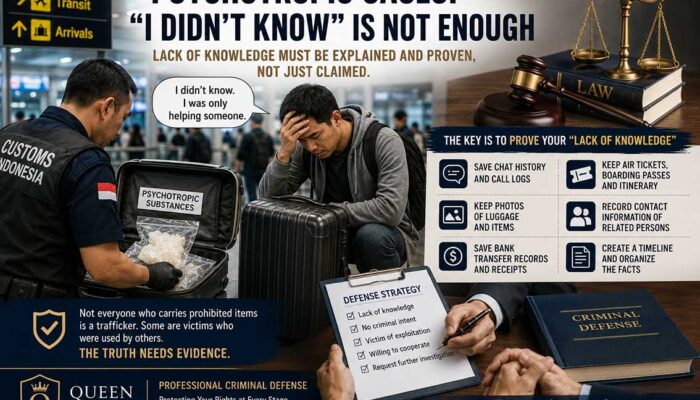
In psychotropic cases, ignorance is not something that can merely be stated.

Ignorance must be explained and proven.

I. A Common Story: Carrying a Package for Someone Else, Then Being Arrested

Imagine a person traveling from Milan to Hong Kong, with a transit stop in Indonesia.

Before departure, an acquaintance asks the traveler to carry a suitcase. The traveler is told that it contains clothing, personal belongings, or items intended for family members.

The traveler believes the explanation.

The traveler does not open the suitcase.

The traveler does not believe that any crime is being committed.

The traveler simply thinks he or she is helping someone.

However, during transit in Indonesia, the suitcase is inspected. Law enforcement officers discover psychotropic substances inside. In an instant, what began as an ordinary journey becomes a serious criminal matter.

The traveler panics and says:

“I did not know.”

“The suitcase is not mine.”

“I was only carrying it for someone else.”

From a human perspective, such panic is understandable. In legal proceedings, however, those statements alone are not sufficient.

Law enforcement authorities are still required to investigate. The police must continue gathering facts. Prosecutors must assess the case file. Ultimately, the court will determine whether the claim of ignorance is reasonable, consistent, and supported by evidence.

Accordingly, the key question is no longer merely:

“Did the person carry the item?”

Rather, the questions become:

“Did the person know what the item contained?”

“Was the person aware that he or she was transporting psychotropic substances?”

“Was the person part of a criminal network?”

“Or was the person a victim who had been exploited by others?”

This distinction is critically important. Not every person found carrying prohibited substances is automatically a trafficker, dealer, or courier acting with full knowledge of what they were transporting.

II. Why Does “I Did Not Know” Not Automatically Exonerate Someone?

In criminal cases, particularly psychotropic cases, law enforcement authorities generally begin with the facts that can be objectively observed.

For example:

the prohibited substance is found inside a person’s suitcase;

the baggage tag is registered under that person’s name;

the person is engaged in international travel;

the substance is discovered when the person enters or transits through Indonesia;

and the true owner of the substance has not yet been identified.

Based on such preliminary facts, the individual may still be questioned, detained, or even designated as a suspect, despite claiming that he or she had no knowledge of the contents.

This does not mean that everyone is automatically presumed guilty. Rather, the explanation “I did not know” is also frequently used by individuals who knowingly transport prohibited substances. As a result, law enforcement authorities cannot simply stop their inquiry at the point of such a statement.

For a person who genuinely lacked knowledge, the challenge lies in presenting a credible explanation.

For example:

who provided the suitcase;

what relationship existed between the parties;

what information was given regarding the contents of the suitcase;

whether there are chat records or written communications;

who purchased the airline ticket;

whether any money was provided;

whether the person knew the suitcase combination or access code;

whether the suitcase had ever been opened;

and whether the person immediately identified the individual who entrusted the suitcase to him or her from the outset.

The clearer the answers to these questions, the stronger the defense position becomes.

Conversely, if the answers change over time, lack consistency, or are unsupported by evidence, the defense becomes significantly weaker.

III. Innocent People Often Say the Wrong Things When They Panic

One of the greatest challenges in cases of this nature is that innocent individuals often panic during the initial examination.

They are afraid.

They are confused.

They may not understand the language being used.

They may not be aware of their legal rights.

They may not understand the legal consequences of the answers they provide.

For example, an officer may ask:

“Is this your suitcase?”

The individual responds:

“Yes.”

What the person actually means is that the suitcase was being carried during the journey. It does not necessarily mean that the suitcase belongs to him or her. The suitcase may simply have been entrusted to that person by someone else.

Or an officer may ask:

“Do you know what is inside?”

The individual responds:

“I was told it contained clothing.”

If not properly explained, such an answer can create problems. It may appear as though the person had knowledge of the contents of the suitcase, when in reality he or she was merely repeating information provided by the individual who entrusted the suitcase.

For this reason, initial statements are extremely important in psychotropic cases.

A clearer and safer response may be:

“I was carrying the suitcase, but it does not belong to me. I received it from a person named X. I was only informed that it contained clothing or personal belongings. I was never informed, nor did I know, that the suitcase contained psychotropic substances.”

Such a statement is more complete. It does not deny the fact that the suitcase was being carried, while at the same time explaining that the suitcase belonged to another person and that the contents were unknown to the carrier.

In criminal proceedings, the truth must be communicated accurately.

Not for the purpose of creating a story, but to ensure that the facts are not misunderstood.

IV. Evidence That Should Be Collected Immediately

Many families assume that evidence in a case like this must always be complicated.

In reality, that is not necessarily the case.

Many important pieces of evidence are often already in the possession of the individual involved or his or her family.

For example:

WhatsApp, Telegram, WeChat, Line, SMS, email, or social media communications with the person who entrusted the item;

telephone call records;

airline tickets;

boarding passes;

baggage tags;

proof of ticket payment;

records of money transfers;

hotel booking confirmations;

photographs of the suitcase or the items before departure;

the name and telephone number of the person who provided the item;

the name and telephone number of the person intended to receive the item at the destination country;

messages indicating that the item contained clothing, medicine, supplements, gifts, documents, or personal belongings;

and statements from family members or friends who knew that the individual was merely carrying an item on behalf of someone else.

Evidence of this nature may appear simple.

However, in psychotropic cases, simple evidence can be extremely important.

For example, there may be a message stating:

“Please help bring this suitcase. It contains clothing.”

Such a message does not automatically result in acquittal.

However, it may help demonstrate that the individual was informed that the suitcase contained clothing rather than psychotropic substances.

Similarly, there may be evidence showing that the airline ticket was purchased by another person. This may indicate that the journey was arranged by someone else. Nevertheless, such evidence must be explained carefully.

Otherwise, it may be interpreted as payment for acting as a courier.

For that reason, evidence should not merely be collected.

Evidence must be organized, examined, and explained within a proper defense framework.

What must never be done is deleting messages, editing conversations, fabricating evidence, or inventing new facts.

A single falsehood can undermine many genuine facts that might otherwise assist the defense.

V. Families Should Not Panic, But They Must Act Quickly

When a family learns that one of its members has been arrested in connection with a psychotropic case, panic is often the first reaction.

That reaction is understandable.

However, after the initial panic, the family must act promptly and systematically.

The following steps should be taken:

preserve all communications between the individual and the person who entrusted the item;

record the names, telephone numbers, social media accounts, addresses, and other identifying information of relevant individuals;

retain airline tickets, hotel reservations, transfer records, and travel itineraries;

determine who paid for the airline ticket;

identify anyone who was aware of the trip;

prepare a simple chronology based on the available information;

and seek legal assistance immediately.

Families should also proceed with caution.

Do not make accusations on social media.

Do not contact individuals suspected of setting up or deceiving the person involved without proper legal guidance.

Do not trust individuals who claim that the matter can be resolved through unofficial means.

Psychotropic cases are serious criminal matters.

The safest course is a well-structured legal defense, not vague promises of informal solutions.

VI. A Defense Must Begin at the Earliest Stage, Not After the Case Reaches Trial

One of the most common mistakes is waiting until the case has progressed significantly through the police investigation stage, or even until the case is about to be transferred to the prosecution authorities, before seeking legal counsel.

In psychotropic cases, however, the most serious damage often occurs at the very beginning.

The individual may have already signed an examination report without fully understanding its contents.

The individual may have provided incomplete statements.

The individual may have failed to immediately identify the person who entrusted the item.

The individual may not have requested an interpreter despite not understanding the language used during questioning.

The family may have failed to secure digital evidence in time.

The person who entrusted the item may have disappeared.

Telephone numbers may no longer be active.

Social media accounts may have been deleted.

For these reasons, legal assistance from the earliest stage is critically important.

Legal representation is not intended to teach someone how to lie.

It is not intended to create a story.

It is not intended to avoid the law.

Legal representation is necessary to ensure that a person who is genuinely a victim can explain the events accurately, coherently, consistently, and without unintentionally harming his or her own legal position.

VII. The Defense Theory That Must Be Established