Author: Irfan Disnizar

Ignorance That Must Be Proven: A Defense in Psychotropic Cases

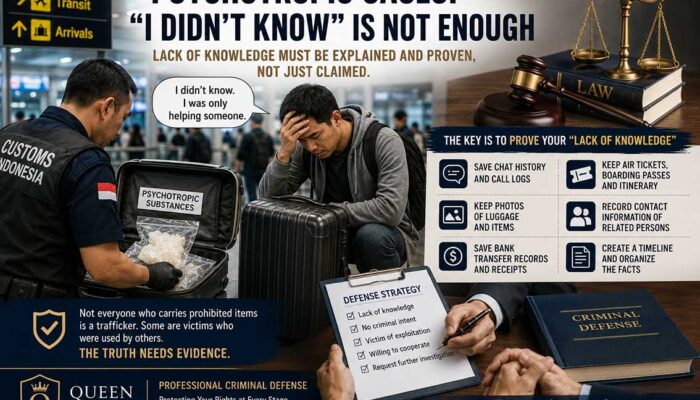
There is one statement that frequently arises when a person is apprehended while carrying an item containing psychotropic substances:

“I did not know.”

That statement may be true.

It may also be untrue.

The problem is that, in psychotropic cases, the law is not satisfied merely by hearing the words “I did not know.” The law will inquire further:

If you did not know, why was the item in your possession?

Who gave it to you?

When did you receive it?

What were you told about its contents?

Did you open the suitcase or package?

Were you paid?

Who arranged the trip?

Who was supposed to receive the item at the destination?

Questions such as these often surprise ordinary people. From the perspective of a potential victim, he or she may feel that they were merely helping someone transport an item. From the perspective of law enforcement authorities, however, the prohibited substance was found in that person’s possession or under that person’s control during the journey.

This is where the real issue lies.

In psychotropic cases, ignorance is not something that can merely be stated.

Ignorance must be explained and proven.

I. A Common Story: Carrying a Package for Someone Else, Then Being Arrested

Imagine a person traveling from Milan to Hong Kong, with a transit stop in Indonesia.

Before departure, an acquaintance asks the traveler to carry a suitcase. The traveler is told that it contains clothing, personal belongings, or items intended for family members.

The traveler believes the explanation.

The traveler does not open the suitcase.

The traveler does not believe that any crime is being committed.

The traveler simply thinks he or she is helping someone.

However, during transit in Indonesia, the suitcase is inspected. Law enforcement officers discover psychotropic substances inside. In an instant, what began as an ordinary journey becomes a serious criminal matter.

The traveler panics and says:

“I did not know.”

“The suitcase is not mine.”

“I was only carrying it for someone else.”

From a human perspective, such panic is understandable. In legal proceedings, however, those statements alone are not sufficient.

Law enforcement authorities are still required to investigate. The police must continue gathering facts. Prosecutors must assess the case file. Ultimately, the court will determine whether the claim of ignorance is reasonable, consistent, and supported by evidence.

Accordingly, the key question is no longer merely:

“Did the person carry the item?”

Rather, the questions become:

“Did the person know what the item contained?”

“Was the person aware that he or she was transporting psychotropic substances?”

“Was the person part of a criminal network?”

“Or was the person a victim who had been exploited by others?”

This distinction is critically important. Not every person found carrying prohibited substances is automatically a trafficker, dealer, or courier acting with full knowledge of what they were transporting.

II. Why Does “I Did Not Know” Not Automatically Exonerate Someone?

In criminal cases, particularly psychotropic cases, law enforcement authorities generally begin with the facts that can be objectively observed.

For example:

the prohibited substance is found inside a person’s suitcase;

the baggage tag is registered under that person’s name;

the person is engaged in international travel;

the substance is discovered when the person enters or transits through Indonesia;

and the true owner of the substance has not yet been identified.

Based on such preliminary facts, the individual may still be questioned, detained, or even designated as a suspect, despite claiming that he or she had no knowledge of the contents.

This does not mean that everyone is automatically presumed guilty. Rather, the explanation “I did not know” is also frequently used by individuals who knowingly transport prohibited substances. As a result, law enforcement authorities cannot simply stop their inquiry at the point of such a statement.

For a person who genuinely lacked knowledge, the challenge lies in presenting a credible explanation.

For example:

who provided the suitcase;

what relationship existed between the parties;

what information was given regarding the contents of the suitcase;

whether there are chat records or written communications;

who purchased the airline ticket;

whether any money was provided;

whether the person knew the suitcase combination or access code;

whether the suitcase had ever been opened;

and whether the person immediately identified the individual who entrusted the suitcase to him or her from the outset.

The clearer the answers to these questions, the stronger the defense position becomes.

Conversely, if the answers change over time, lack consistency, or are unsupported by evidence, the defense becomes significantly weaker.

III. Innocent People Often Say the Wrong Things When They Panic

One of the greatest challenges in cases of this nature is that innocent individuals often panic during the initial examination.

They are afraid.

They are confused.

They may not understand the language being used.

They may not be aware of their legal rights.

They may not understand the legal consequences of the answers they provide.

For example, an officer may ask:

“Is this your suitcase?”

The individual responds:

“Yes.”

What the person actually means is that the suitcase was being carried during the journey. It does not necessarily mean that the suitcase belongs to him or her. The suitcase may simply have been entrusted to that person by someone else.

Or an officer may ask:

“Do you know what is inside?”

The individual responds:

“I was told it contained clothing.”

If not properly explained, such an answer can create problems. It may appear as though the person had knowledge of the contents of the suitcase, when in reality he or she was merely repeating information provided by the individual who entrusted the suitcase.

For this reason, initial statements are extremely important in psychotropic cases.

A clearer and safer response may be:

“I was carrying the suitcase, but it does not belong to me. I received it from a person named X. I was only informed that it contained clothing or personal belongings. I was never informed, nor did I know, that the suitcase contained psychotropic substances.”

Such a statement is more complete. It does not deny the fact that the suitcase was being carried, while at the same time explaining that the suitcase belonged to another person and that the contents were unknown to the carrier.

In criminal proceedings, the truth must be communicated accurately.

Not for the purpose of creating a story, but to ensure that the facts are not misunderstood.
IV. Evidence That Should Be Collected Immediately

Many families assume that evidence in a case like this must always be complicated.

In reality, that is not necessarily the case.

Many important pieces of evidence are often already in the possession of the individual involved or his or her family.

For example:

WhatsApp, Telegram, WeChat, Line, SMS, email, or social media communications with the person who entrusted the item;

telephone call records;

airline tickets;

boarding passes;

baggage tags;

proof of ticket payment;

records of money transfers;

hotel booking confirmations;

photographs of the suitcase or the items before departure;

the name and telephone number of the person who provided the item;

the name and telephone number of the person intended to receive the item at the destination country;

messages indicating that the item contained clothing, medicine, supplements, gifts, documents, or personal belongings;

and statements from family members or friends who knew that the individual was merely carrying an item on behalf of someone else.

Evidence of this nature may appear simple.

However, in psychotropic cases, simple evidence can be extremely important.

For example, there may be a message stating:

“Please help bring this suitcase. It contains clothing.”

Such a message does not automatically result in acquittal.

However, it may help demonstrate that the individual was informed that the suitcase contained clothing rather than psychotropic substances.

Similarly, there may be evidence showing that the airline ticket was purchased by another person. This may indicate that the journey was arranged by someone else. Nevertheless, such evidence must be explained carefully.

Otherwise, it may be interpreted as payment for acting as a courier.

For that reason, evidence should not merely be collected.

Evidence must be organized, examined, and explained within a proper defense framework.

What must never be done is deleting messages, editing conversations, fabricating evidence, or inventing new facts.

A single falsehood can undermine many genuine facts that might otherwise assist the defense.

V. Families Should Not Panic, But They Must Act Quickly

When a family learns that one of its members has been arrested in connection with a psychotropic case, panic is often the first reaction.

That reaction is understandable.

However, after the initial panic, the family must act promptly and systematically.

The following steps should be taken:

preserve all communications between the individual and the person who entrusted the item;

record the names, telephone numbers, social media accounts, addresses, and other identifying information of relevant individuals;

retain airline tickets, hotel reservations, transfer records, and travel itineraries;

determine who paid for the airline ticket;

identify anyone who was aware of the trip;

prepare a simple chronology based on the available information;

and seek legal assistance immediately.

Families should also proceed with caution.

Do not make accusations on social media.

Do not contact individuals suspected of setting up or deceiving the person involved without proper legal guidance.

Do not trust individuals who claim that the matter can be resolved through unofficial means.

Psychotropic cases are serious criminal matters.

The safest course is a well-structured legal defense, not vague promises of informal solutions.

VI. A Defense Must Begin at the Earliest Stage, Not After the Case Reaches Trial

One of the most common mistakes is waiting until the case has progressed significantly through the police investigation stage, or even until the case is about to be transferred to the prosecution authorities, before seeking legal counsel.

In psychotropic cases, however, the most serious damage often occurs at the very beginning.

The individual may have already signed an examination report without fully understanding its contents.

The individual may have provided incomplete statements.

The individual may have failed to immediately identify the person who entrusted the item.

The individual may not have requested an interpreter despite not understanding the language used during questioning.

The family may have failed to secure digital evidence in time.

The person who entrusted the item may have disappeared.

Telephone numbers may no longer be active.

Social media accounts may have been deleted.

For these reasons, legal assistance from the earliest stage is critically important.

Legal representation is not intended to teach someone how to lie.

It is not intended to create a story.

It is not intended to avoid the law.

Legal representation is necessary to ensure that a person who is genuinely a victim can explain the events accurately, coherently, consistently, and without unintentionally harming his or her own legal position.

VII. The Defense Theory That Must Be Established

Learning From the PT U Case: How to Avoid the Trap of Futures Investment in Indonesia

In recent years, the Indonesian public has become increasingly familiar with the term futures or futures trading. Some regard it as a modern investment instrument, others as a shortcut to getting rich. Many first hear of it through offers from friends or advertisements on social media. Yet, behind its alluring image, there are many bitter stories. One of them comes from the case of PT U—a futures brokerage company that once operated legally but was eventually frozen by the Commodity Futures Trading Supervisory Agency (Bappebti) and went into liquidation.

Many people felt deceived, lost their savings, and even suffered stress because their funds disappeared just like that. This article is not intended to discredit anyone. On the contrary, it seeks to draw lessons from the PT U case to educate the public: what futures are, how to protect oneself from risk, and what can be done if one has already become a victim.

WHAT ARE FUTURES AND WHY ARE THEY HIGH-RISK?

In simple terms, futures are trading contracts that promise the purchase or sale of a commodity or financial instrument in the future at a price determined today. In Indonesia, futures are regulated by Law No. 32 of 1997 on Commodity Futures Trading, as amended by Law No. 10 of 2011. Bappebti is the authority entrusted with supervision, similar to the Financial Services Authority (OJK) in the financial sector. Futures brokerage firms must be registered and officially licensed by Bappebti.

However, it is important to understand: futures are not savings, not deposits, and not fixed-interest investments. They are high-risk, high-return instruments. This means there is a chance of profit, but also a substantial risk of loss. Therefore, it is misleading when anyone promises guaranteed returns or “certain profits.”

LESSONS FROM THE PT U CASE

The PT U case provides a valuable lesson. Many customers deposited funds not through official mechanisms but via certain individuals’ accounts or under schemes claiming to be “more profitable.” Most also failed to sign the standard documents required by Bappebti. As a result, when PT U entered liquidation, many customers were not recognized as official clients. Their claims were rejected because, under the law, only funds deposited into official segregated accounts were protected.

What is a segregated account?
According to Bappebti Regulation No. 5 of 2018, every customer must have a separate account (segregated account). Customer funds must not be mixed with the company’s operational funds. The principle is similar to an escrow account: money can only be used for legitimate and recorded transactions. Unfortunately, the public’s lack of knowledge was exploited. In the end, when the company shut down, funds deposited outside official mechanisms were deemed non-existent in the system.

REAL RISKS FACING CUSTOMERS

The PT U case highlights several fatal risks that can befall the public:

  1. Loss of Claim Rights
    Funds not deposited into segregated accounts are automatically unrecognized. Thus, even with transfer receipts, the customer’s legal position is weak.

  2. Total Financial Loss
    Many victims lost their entire capital, often money earned through years of hard work.

  3. Difficulty in Suing Management
    Without official documents, it is very difficult to bring a case to court. Personal transfer records are often deemed insufficient.

  4. Psychological Trauma
    Many victims became reluctant to invest again and even suffered mental distress from feeling defrauded.

HOW TO PROTECT YOURSELF?

To avoid falling into the trap, the public should take the following preventive steps:

  • Check Legality
    Ensure that the futures brokerage company is truly registered on Bappebti’s official website. Do not rely solely on brochures or testimonials.

  • Use a Segregated Account
    Never deposit money into an individual’s personal account. Request that a segregated account be opened in your name, in compliance with regulations.

  • Sign Standard Documents
    Pursuant to Bappebti Regulation No. 4 of 2020, every customer must sign standard agreements. These documents are the primary legal basis in case of disputes.

  • Avoid Promises of Fixed Returns
    Remember: futures are speculative instruments. If someone promises “guaranteed profits,” it is a red flag.

  • Report Irregularities
    If you find indications of violations, report them immediately to Bappebti or the police.

PUBLIC EDUCATION AS THE MAIN DEFENSE

Legal protection alone is not enough if the public does not understand the risks. Therefore, public education is crucial. Several measures can be taken:

  1. Financial Literacy from an Early Age
    The public must understand that investing is different from saving. Investment always carries risk.

  2. More Aggressive Regulatory Campaigns
    Bappebti should not only publish the list of licensed companies but also actively educate the public on fraudulent schemes.

  3. Product Transparency
    Brokerage firms must explain risks in plain language, not just technical figures.

  4. Collaboration with Academics and Lawyers
    Universities, law firms, and professional associations can create educational modules for the public.

  5. Early Warning System
    Indonesia can follow other countries that publish early warning lists of problematic companies to increase public vigilance.

With consistent education, people will not only be more discerning in choosing investments but also more resilient against fraudulent persuasion.

IF YOU ARE ALREADY A VICTIM, WHAT CAN BE DONE?

For those who have already suffered losses, there are still legal avenues, although not easy:

  1. Civil Claim for Unlawful Acts (Tort)
    Based on Article 1365 of the Civil Code. If negligence or unlawful conduct by company management can be proven, customers can claim damages.

  2. Claim of Abuse of Circumstances
    In some cases, judges may consider that customers were deceived because their ignorance was exploited. This doctrine is recognized in civil law practice, though not always easy to prove.

  3. Criminal Report
    If fraud or embezzlement is suspected, victims may report under Article 378 of the Criminal Code (fraud) or Article 372 of the Criminal Code (embezzlement).

  4. Class Action
    If there are many victims, a class action lawsuit can be pursued to strengthen legal standing.

Although results do not always guarantee the recovery of funds, legal action is important as a form of resistance so that perpetrators do not walk free.

REFLECTIONS FROM THE PT U CASE

The PT U case reveals two sides. On the one hand, regulations are already fairly robust, such as the requirement for segregated accounts and Bappebti’s supervision. On the other hand, there remain major gaps because the public is undisciplined and easily lured by sweet promises.

Therefore, the PT U case should serve as a mirror. We cannot only blame regulators or companies. Customers too have a duty to be critical, cautious, and compliant with procedures.

CONCLUSION

Futures trading is legal in Indonesia and can serve as a legitimate investment instrument. But legality alone is not enough. Risks always exist and can be fatal if the public is undisciplined.

From the PT U case, three key messages emerge:

  1. Prevention is cheaper than cure. Do not be tempted by sweet promises; always check legality and use segregated accounts.

  2. Public education must be strengthened. Only with proper financial literacy can society resist fraudulent schemes.

  3. Do not remain silent if harmed. Pursue legal avenues: tort claims, abuse of circumstances, criminal reports, or class actions.

With the right understanding, we can turn the PT U case into a valuable lesson so that both Indonesians and the international community are better protected in the future.

Futures are not to be feared, but neither should they become a trap. It all comes down to legal discipline and our collective awareness.

The Secret to Successfully Planning and Managing Mixed Marriages Between Indonesian Citizens and Foreign Nationals in Indonesia: A New Approach for Extraordinary Results

The main purpose of this writing is to gain a deep understanding of the steps to plan and undertake a mixed marriage between Indonesian citizens (WNI) and foreign nationals (WNA) in Indonesia, and to apply a new approach that can result in an extraordinary and harmonious relationship.

Chapter 1: Preparation for Planning Mixed Marriages between Indonesian Citizens and Foreign Nationals

I. Understanding the Process of Preparing for Mixed Marriages in Indonesia

Planning a mixed marriage between an Indonesian citizen (WNI) and a foreign national (WNA) requires thorough preparation and a deep understanding of the involved processes. The first crucial step is to communicate openly with your partner about expectations, values, and goals for the marriage. Discuss cultural differences, traditions, and beliefs to reach a better understanding from the outset.

General steps in the process of planning a mixed marriage in Indonesia include:

  1. Collecting the required documents (birth certificate, passport, certificate of no impediment, etc.)
  2. Fulfilling legal and administrative requirements (such as visas and residence permits for the foreign national)
  3. Choosing a location and arranging the wedding ceremony according to cultural and traditional practices
  4. Completing the official marriage registration process

Factors such as culture, religion, location, and family circumstances also need to be considered in the planning of this mixed marriage.

II. Legal and Administrative Requirements

To conduct a mixed marriage in Indonesia, there are several legal and administrative requirements that both parties must fulfill. For Indonesian citizens, the required documents include a birth certificate, an identity card (KTP), and a certificate of no impediment from the local village/municipality office.

For foreign nationals, additional requirements include:

  • A valid passport
  • A limited stay visa (VITAS) or a permanent stay permit (ITAP) issued by the local immigration office
  • A certificate of no impediment from the embassy/consulate of the country of origin
  • Other legal documents such as a marriage permit from the embassy/consulate (if required)

Once all documents are complete, the couple can apply for marriage registration at the Civil Registry Office or the Office of Religious Affairs, depending on the religion they follow.

Case Study Example:

An Indonesian man named Budi and a French woman named Marie plan to marry in Indonesia. They collected all the necessary documents, including Marie’s passport, a certificate of no impediment from the French embassy, and Marie’s residence permit in Indonesia. After fulfilling all requirements, they successfully registered their marriage at the Civil Registry Office in Jakarta.

III. Building Communication and Understanding from the Start

Open communication and building understanding from the beginning are key to a successful mixed marriage. The couple should honestly and openly discuss their expectations, values, and goals. Cultural differences, traditions, and beliefs should be respected and understood by both parties.

Strategies for building understanding and a shared vision include:

  • Deeply learning about each other’s cultures
  • Discussing how to integrate traditions and values into the marriage
  • Setting common goals and future visions
  • Compromising and being willing to make adjustments if needed

Practical tips to enhance effective communication:

  • Be a good listener and show empathy
  • Use clear language and avoid assumptions
  • Be open to accepting differing opinions
  • Practice patience and emotional control during conflicts

IV. Financial and Future Planning

Financial and future planning are also important factors in a mixed marriage. The couple should openly discuss each other’s financial situation and how to manage finances together after marriage.

Consider future living and work options. Will you live in Indonesia or your partner’s home country? What are the career prospects and job opportunities for each party?

Additionally, it is important to prepare essential documents such as a will, insurance, and other financial plans to secure the family’s future.

Case Study Example:

An Indonesian woman named Sari and a German man named Hans plan to marry in Indonesia. They openly discussed their financial situations and developed a joint financial plan. They also considered long-term living in Indonesia, so Hans needed to find a job in Indonesia or start his own business. They also prepared a will and insurance to secure their family’s future.

By understanding the preparation process, fulfilling legal and administrative requirements, building communication and understanding from the start, and planning finances and the future, Indonesian and foreign national couples can effectively prepare for a mixed marriage and create a strong foundation for a harmonious and lasting relationship.

Chapter 2: Rituals and Procedures for Mixed Marriages in Indonesia

I. Aligning the Wedding Ceremony with Culture and Tradition

After preparing all the legal and administrative requirements, the next step is to organize the wedding procession itself. In mixed marriages, it is crucial to respect and combine both parties’ cultures and traditions in the wedding ceremony.

Some aspects to consider include:

  • Location and venue of the wedding ceremony (building, place of worship, etc.)
  • Traditional rituals and processions according to each culture
  • Wedding attire and decorations that reflect cultural fusion
  • Food and dishes that represent the culinary tastes of both parties

Be sure to discuss with extended family and seek advice on how to harmoniously and meaningfully blend these traditions.

II. Understanding the Importance of Respecting Cultural Differences

In mixed marriages, respecting cultural differences is key to creating a meaningful ceremony accepted by all parties. Each culture has unique traditions and rituals that may differ from others.

Some tips for respecting cultural differences include:

  • Learn and understand the meaning behind each ritual and tradition
  • Show respect and be open to accepting differences
  • Do not impose your own views or culture
  • Involve extended family and traditional leaders for guidance

By understanding and respecting cultural differences, couples can create a unique wedding ceremony that harmoniously reflects cultural fusion.

III. Aligning Rituals and Procedures According to Preferences

After understanding the importance of respecting cultural differences, the next step is to align the wedding rituals and procedures according to the preferences of both parties.

Some strategies to consider include:

  • Dividing the ceremony into several sessions that reflect each culture
  • Combining certain elements from both cultures into one ceremony
  • Using symbols or decorations that represent both cultures
  • Inviting religious or traditional leaders from both sides to lead the ceremony

Always communicate with your partner and extended family to reach an agreement on the desired form of the ceremony.

IV. Case Study: Indonesian-Japanese Mixed Marriage

For example, let’s look at a case study of a mixed marriage between an Indonesian man named Adi and a Japanese woman named Yuki.

In their wedding ceremony, they combined Javanese and Japanese traditions. The procession began with Javanese traditional ceremonies such as siraman (ritual bathing), midodareni (pre-wedding night), and ijab kabul (marriage contract). Afterward, they continued with a sacred Shinto wedding ceremony at a Japanese shrine.

The wedding attire also reflected cultural fusion, with Adi wearing Javanese beskap and Yuki wearing a traditional Japanese kimono. The decorations and dishes also combined elements from both cultures.

By aligning the rituals and procedures according to their preferences, Adi and Yuki successfully created a unique and meaningful wedding ceremony while respecting their cultural differences.

By understanding the importance of respecting cultural differences and using strategies to align the rituals and procedures according to preferences, Indonesian-foreign couples can create a beautiful wedding ceremony that harmoniously reflects cultural fusion.

Chapter 3: Facing Challenges in Mixed Marriages between Indonesian Citizens and Foreign Nationals

I. Discussing Potential Challenges

Although mixed marriages can be enriching and broaden one’s perspectives, couples must also be prepared to face various challenges that may arise. Some common challenges in mixed marriages include:

  • Cultural and Traditional Differences
    • Different values, norms, and expectations
    • Different ways of communicating and interacting
    • Different family traditions and religious practices
  • Language and Communication Issues
    • Difficulties in communicating effectively
    • Risk of misunderstandings and conflicts
  • Legal and Administrative Issues
    • Complex immigration and visa regulations
    • Property and inheritance issues
  • Challenges in Raising Children
    • How to teach and preserve each culture
    • Choosing the language to be used at home
  • Pressure from Extended Family and Social Environment
    • Lack of acceptance or support from extended family
    • Stereotypes and prejudices from the social environment

II. Strategies for Overcoming Differences in Culture, Language, and Values

To overcome these challenges, couples need to develop effective strategies. Some strategies to consider include:

  • Learning and Appreciating Each Other’s Culture
    • Study the history, traditions, and values of your partner’s culture
    • Show respect and openness to accept differences
  • Improving Communication Skills
    • Learn your partner’s language and use a translator if necessary
    • Practice active listening and clear communication
  • Finding Common Ground and Compromising
    • Discuss expectations and make mutual agreements
    • Find creative solutions that respect both sets of values
  • Building a Support Network
    • Join mixed marriage communities
    • Seek advice from experienced mixed couples

III. Emphasizing the Importance of Patience and Understanding in Facing Conflict

In facing the challenges of a mixed marriage, patience and understanding are crucial to avoiding conflicts and maintaining harmony in the relationship. Some tips to consider include:

  • Learn to Control Emotions and Think Clearly
  • Appreciate Differences and Avoid Imposing Your Own Views
  • Be Willing to Compromise and Find Solutions Together
  • Build Trust and Mutual Respect
  • Seek Professional Help if Necessary (marriage counseling, etc.)

IV. Case Study: Indonesian-Foreign Couple Facing Cultural Challenges

For example, let’s look at a case study of an Indonesian-foreign couple facing cultural challenges in raising their child.

An Indonesian man named Rudi married an English woman named Emily. They had a son. Rudi wanted to teach his son Indonesian traditions and culture, while Emily also wanted their child to know English culture.

To address this challenge, Rudi and Emily found common ground and compromised. They agreed to teach both cultures to their son, with Rudi teaching Indonesian language and traditions and Emily teaching English language and culture.

Additionally, they joined a mixed marriage community in their city to gain support and advice from other couples in similar situations.

With patience, understanding, and a willingness to compromise, Rudi and Emily successfully overcame the cultural challenges in raising their son harmoniously.

By understanding the challenges that may arise, developing strategies to overcome differences, and practicing patience and understanding, Indonesian-foreign couples can overcome various challenges in mixed marriages and build strong and harmonious relationships.

Chapter 4: Building Communication and Harmony in Mixed Marriages

I. Tips for Enhancing Effective Communication between Mixed Couples

Effective communication is crucial for maintaining harmony in marital relationships, especially in mixed marriages involving cultural and language differences. Here are some tips to improve communication between mixed couples:

  • Learn Your Partner’s Language
    • Strive to learn your partner’s language, at least at a basic level
    • This will help reduce misunderstandings and make communication smoother
  • Practice Active Listening
    • Pay full attention when your partner speaks
    • Show interest by asking questions and summarizing the essence of the conversation
  • Use Positive Body Language
    • Eye contact, nodding, and smiling can strengthen the message conveyed
  • Be a Clear Communicator
    • Avoid assumptions and express thoughts and feelings clearly
    • Use a translator or other communication aids if necessary

II. Understanding the Importance of Mutual Support and Building Trust

In addition to effective communication, mutual support and trust are also crucial for maintaining harmony in mixed marriages. Here are some steps that can be taken:

  • Show Support and Appreciation
    • Support your partner’s interests, hobbies, and career
    • Appreciate differences and value each other’s contributions in the relationship
  • Build Trust through Honesty and Openness
    • Be open and honest in expressing thoughts and feelings
    • Avoid hiding information or lying to your partner
  • Respect Privacy and Individual Space
    • Allow space and time for individual activities and personal time
    • Avoid excessive interference in your partner’s privacy
  • Create Traditions and Shared Moments
    • Establish new traditions and routines that reflect your combined cultures
    • Celebrate important moments in life with your unique style

III. Strategies for Maintaining Relationship Harmony in Mixed Marriages

To maintain relationship harmony in mixed marriages, consistent strategies and efforts are necessary. Here are some strategies to consider:

  • Continuously Learn about Your Partner’s Culture
    • Show interest and curiosity about your partner’s culture
    • Learn about the history, traditions, and values upheld by your partner
  • Be Flexible and Open to Compromise
    • Avoid imposing your own views or culture
    • Seek creative solutions that respect both sides’ values
  • Allocate Quality Time Together
    • Schedule time for shared activities such as romantic dinners or vacations
    • Avoid being too busy with work or individual activities
  • Seek Professional Help if Needed
    • Don’t hesitate to seek marriage counseling or therapy
    • This can help address conflicts and strengthen the relationship

IV. Case Study: WNI-WNA Couple Building Communication and Harmony

As an example, let’s look at a case study of a WNI-WNA couple who successfully built communication and harmony in their marriage.

Sarah, a woman from Australia, married Andi, a man from Indonesia. At the beginning of their marriage, they faced communication challenges due to language and cultural differences.

To overcome these challenges, Sarah intensively studied Indonesian language, while Andi worked on improving his English skills. They also practiced active listening and expressed thoughts and feelings clearly.

Furthermore, Sarah and Andi supported and appreciated each other’s interests. Sarah supported Andi in pursuing his career, while Andi provided space for Sarah to develop her painting hobby.

They also created new traditions reflecting their combined culture, such as alternating celebrations of Eid al-Fitr and Christmas each year.

Through consistent efforts in building communication, mutual support, and creating togetherness, Sarah and Andi successfully maintained harmony in their mixed marriage.

By implementing appropriate tips and strategies, WNI-WNA couples can build effective communication, mutual support, and maintain harmony in their mixed marriages, thereby creating a strong and lasting relationship.

Chapter 5: Life After Marriage: Maintaining Happiness and Harmony

I. Explaining the Importance of Adaptation and Compromise in Married Life

After going through the stages of preparation, wedding ceremonies, and facing various challenges, WNI-WNA couples enter a new phase in their lives as husband and wife. During this phase, the ability to adapt and compromise becomes crucial to maintain happiness and harmony in the relationship.

Adapting to Lifestyle Changes

  • Adjusting daily routines and habits
  • Sharing roles and responsibilities in the household

Compromising in Decision-Making

  • Learning to negotiate and find win-win solutions
  • Valuing each other’s opinions and desires

Flexibility in Planning for the Future

  • Being open to adjusting plans according to changing circumstances
  • Discussing choices such as residence, careers, and raising children

II. Tips for Continuously Nurturing a Happy and Harmonious Relationship

Despite being married, it’s important for couples to continue making efforts to nurture and maintain happiness and harmony in their relationship. Here are some tips to consider:

Allocate Special Time for Each Other

  • Schedule romantic moments like dinners or vacations together
  • Avoid being too caught up in work or other activities

Maintain Open and Honest Communication

  • Share thoughts, feelings, and hopes openly
  • Listen attentively and show empathy

Continuously Learn and Appreciate Each Other’s Cultures

  • Show interest in continually learning about your partner’s culture
  • Respect and preserve each other’s traditions in daily life

Create Togetherness and Intimacy

  • Engage in enjoyable activities together
  • Maintain physical and emotional intimacy in the relationship

III. Strategies for Planning a Successful and Fulfilling Future Together

In addition to maintaining current happiness and harmony, it’s crucial for WNI-WNA couples to plan a successful and fulfilling future together. Here are some strategies to consider:

Discussing Shared Goals and Priorities

  • Setting long-term goals such as careers, finances, and raising children
  • Establishing priorities and steps to achieve these goals

Planning Finances Wisely

  • Creating a budget together and managing expenses
  • Considering investments and retirement planning

Preparing for the Future of Children (if applicable)

  • Discussing education and cultural heritage to be imparted
  • Planning savings or insurance for children’s education

Remaining Flexible and Ready to Adapt

  • Being willing to adjust plans according to changing situations and needs
  • Making decisions together as partners in important matters

IV. Case Study: WNI-WNA Couple Maintaining Happiness and Planning for the Future

As an example, let’s examine a case study of a WNI-WNA couple who have successfully maintained happiness and planned for their future.

Tono, a man from Indonesia, married Laura, a woman from Spain. After marriage, they faced challenges in adapting to a new lifestyle and dividing roles in the household.

To overcome this, Tono and Laura were willing to compromise and adjust to each other. They shared household tasks fairly and discussed every important decision together.

Additionally, they always made time for special moments together, such as romantic dinners or vacations. They also continued to learn about and appreciate each other’s cultures, fostering togetherness and intimacy in their relationship.

In planning for the future, Tono and Laura discussed shared goals and priorities, such as careers, finances, and raising children. They created a budget together and planned savings for their future children’s education.

Through consistent efforts in maintaining happiness and harmony, as well as thoughtful planning for the future, Tono and Laura have built a successful and fulfilling relationship as a WNI-WNA couple.

By applying appropriate strategies, WNI-WNA couples can maintain happiness and harmony in their married life, while planning for a successful and satisfying future together. Key elements include adaptation, compromise, open communication, and wise planning.

Closing:

Preparing for and navigating a cross-cultural marriage between Indonesian nationals (WNI) and foreign nationals (WNA) indeed presents its own set of challenges. However, with thorough preparation, deep cultural understanding, and a willingness to adapt and compromise, WNI-WNA couples can navigate these challenges and build a harmonious and enduring relationship.

At Queen Law Firm, we understand the complexities involved in the process of cross-cultural marriage. As a leading law firm in Indonesia, we offer integrated services to assist WNI-WNA couples in smoothly handling all legal and administrative aspects.

Choosing our services provides several key benefits:

Expertise and Experience: Our team comprises experienced lawyers who have a deep understanding of the laws and regulations related to cross-cultural marriages in Indonesia. We can provide accurate guidance and solutions for every unique situation you may face.

Efficiency and Speed of Process: With strong networks and connections with relevant authorities, we ensure that administrative processes and legal requirements proceed smoothly and swiftly, allowing you to focus on other wedding preparations.

Personal Approach and Empathy: We recognize that every couple has unique situations and needs. Therefore, we offer a personalized and empathetic approach in serving each client, carefully listening to your needs and expectations.

Security and Confidentiality Assurance: We are committed to maintaining the security and confidentiality of your personal data and information throughout the cross-cultural marriage handling process.

At Queen Law Firm, we believe that cross-cultural marriages not only unite two individuals but also enrich cultural differences and traditions. With our services, we hope to assist WNI-WNA couples in realizing their wedding dreams more easily and enjoying happiness and harmony in their relationship.

Feel free to contact us and utilize our services in planning and experiencing your cross-cultural marriage. Let Queen Law Firm be your trusted partner to ensure that the legal and administrative processes run smoothly, allowing you to focus on building a strong and enduring foundation with your partner.

Establishment of Supplements and Cosmetics MLM Company

COMPANY ESTABLISHMENT

Retail trading business group of goods by selling them includes trading activities through direct sales or special distribution systems such as single-level marketing and multi-level marketing, as well as retail trade commission agents. (ref. KBLI 47999)

The Business Sector is regulated in Government Regulation No. 29 of 2021.

The Scope of Activities is regulated in Government Regulation No. 5 of 2021, it is required that:

  • Business Entity in the form of Limited Company; and
  • Employ at least 1 Indonesian citizen as a member of the Board of Directors and 1 Indonesian citizen as a member of the Board of Commissioners.

MLM LICENSE

Business licensing requirements

  1. Business entity in the form of Limited Company
  2. Meet the criteria:
    (1) Has exclusive distribution rights for goods to be distributed through direct sales.
    (2) Have a marketing program (marketing plan);
    (3) Have a code of ethics;
    (4) Recruiting direct sellers through a network system;
    (5) Selling goods directly to consumers through a marketing network developed by direct sellers;
    (6) Employ at least 1 Indonesian citizen as a member of the board of directors and 1 Indonesian citizen as a member of the board of commissioners.

Business licensing obligations

  1. The company provides information orally and in writing to prospective direct sellers at least regarding:
    (1) Company identity;
    (2) Quality and specifications of goods;
    (3) the condition and guarantee of the goods and provide an explanation of their use, repair, and maintenance;
    (4) Marketing program (marketing plan);
    (5) Code of ethics.
  2. Companies that have recruited direct sellers must:
    (1) Provide sales aids (starter kit) to each direct seller which at least contains information on goods, marketing plan, and code of ethics;
    (2) Ensuring that the activities carried out by direct sellers are in accordance with the marketing plan and code of ethics;
    (3) Attaching a label on the goods and/or packaging containing at least the name of the company and a statement that the goods are sold using a direct selling system;
    (4) Determine the price of goods sold in rupiah currency and applies to direct sellers and consumers;
    (5) Providing commissions and/or bonuses based on the results of goods sales activities carried out by the direct seller and his network in accordance with the agreement;
    (6) Giving a grace period to the consumer to return the goods within a period of 7 (seven) working days from the receipt of the goods, if it turns out that the goods are not in accordance with the agreement;
    (7) Provide compensation, compensation, and/or compensation for losses caused by the use, use, and utilization of traded goods;
    (8) Carry out coaching and training to improve the ability and knowledge of direct sellers, so that they act correctly, honestly, and responsibly at least once in 1 (one) year;
    (9) Providing equal opportunities to all direct sellers to excel in marketing goods;
    (10) Have a list of direct sellers who are members of their marketing network which is equipped with the identity data of the said direct sellers;
    (11) Selling goods that already have a distribution permit or have complied with the provisions of quality standards in accordance with the provisions of laws and regulations;
    (12) Ensure direct sellers do not sell goods through indirect distribution channels and/or online marketplaces.
  3. The Company submits a report on the Company’s business activities to the Central Government.

CERTIFICATION OF SUPPLEMENTS AND COSMETICS

  • Registration of Supplements and Cosmetics (minister/head of the agency)
  • Distribution Permit for Supplements and Cosmetics (minister/head of the agency)
  • Approval of Supplements and Cosmetics Advertisement (minister/head of the agency)
  • Clinical Trial of Supplements and Cosmetics (minister/head of the agency)
  • Importer recommendation (minister/head of the agency)
  • Recommendation as an applicant for Notification of Supplements and Cosmetics (minister/head of the agency)
  • Supplement and Cosmetic Notification Standard Certificate (minister/head of the agency)
  • Domestic Electronic System Operator Registration Certificate (TD PSE) (minister/head of the agency)

About Business Contracts

Purpose of Designing Business Contracts

Formulate a Contract that can provide legal binding power, as well as provide legal certainty for parties involved in a business / commercial transaction.

The types of trade transactions are becoming increasingly varied and transnational in nature.

Insights on non-legal issues are very important, which can affect the success of a business transaction and fulfill the legitimate expectations of the parties.

Good Business Contract

A good business contract designer must have the willingness and ability to have commercial awareness or understanding of the goals and objectives of a commercial transaction.

A good Business Contract can only be drawn up if a designer can understand:

  • Understanding Transaction / commercial awareness;
  • Understand economic factors, social & political factors, and other non-legal factors;
  • Understand legal provisions, and
  • Be able to put in user-friendly legal language.

Conclusion

In preparing a Business Contract, as a good contract compiler, someone must at least:

Trying to understand the interests/peculiarities/characteristics of these business transactions and bring them to the realm of legal thought to then ground them back to the world of business, namely in the form of BUSINESS CONTRACTS

In other words, translating business deals into the concept of “Contract Law”

Inspired by : Dr. Bayu Seto Hardjowahono, SH., LL.M & Ignatius Denny Lesmana

Peace in Postponement of Obligation to Pay Debt and Bankruptcy

Principle of Peace

“Peace Institution” in the Bankruptcy and Postponement of Debt Payment Obligations Law regime is the embodiment of various principles adhered to in the UUK and at the same time becomes the most important institution in the UUK;

The principle referred to is the Balance Principle, which is the balance between the interests of debtors, creditors and other stakeholders in the Postponement of Debt Payment Obligations and Bankruptcy proceedings;

The principle of business continuity (going concern) becomes very important to protect the business of debtors and creditors, employees, suppliers and other parties directly and indirectly;

The Principles of Transparency and Justice are keywords in the peace process.

The Party That Proposed Peace Plan

1. debtor, When submitting a petition request for himself (voluntary petition). Debtors who estimate in the future will not be able to carry out their obligations to creditors;

2. debtor, When he is declared to have postponed his debt payment obligations;

3. debtor, When he was declared bankrupt;

4. curator, When the debtor is declared bankrupt.

Bad Credit

Bad Credit

Bad credit or problem loans are loans that have difficulty paying off due to factors or intentional elements or due to conditions beyond the ability of the Debtor.

In Indonesia, there are 2 (two) types of credit:

  • Current Credit, and
  • Non-performing Loans:
  • Substandard Credit
  • Doubtful Credit
  • Bad Credit

Cause

The appearance of problem loans does not happen suddenly, it will appear after going through a process, which can be caused by negligence or mistakes of the Creditors (financial service providers) or from the Debtors.

Creditor

Careless apply credit rules, it is too easy to give credit, the concentration of credit funds in a group of debtors, high-risk business sectors, lending that exceeds the ability limit, etc.

Debtor

Declining business conditions due to deteriorating general economic conditions, mismanagement, family problems, business failures, liquidity problems, force majeure, bad temper, etc.

Bad Credit Indication

  • Deferral of abnormal obligations
  • The unexpected investigation from another financial institution
  • Internal problem
  • Changes in the map of market participants / new competitors
  • Increased use of overdraft facilities
  • The company is in chaos
  • Illegal activities were found for the business
  • Request additional credit
  • Request for an extension or reschedule of credit
  • A business that is too expansive
  • Other creditors protect the credit provided by requesting additional collateral or binding a notary for collateral

How to Settle Bad Credit

  • Rescheduling
  • Reconditioning
  • Restructuring
  • Liquidation
  • BANKRUPTCY
  • DELAYING DEBT PAYMENT OBLIGATIONS

About Tax Disputes

The Emergence of Tax Disputes

General Explanation of Law No. 14 of 2002 concerning Tax Courts (PP Law) in the first paragraph explains that:

“The implementation of tax collection that is not by the Taxation Law will cause injustice to the taxpayer community so that it can lead to a Tax Dispute between the taxpayer and the authorized official”.

Tax Dispute

Article 1 point 5 of the PP Law provides an official understanding of the Tax Dispute as follows:

“Tax Disputes are disputes arising in the field of taxation between taxpayers or Tax Insurers and the Authorized Officials as a result of the issuance of decisions that can be appealed or prosecuted to the Tax Court based on tax legislation, including lawsuits over the conduct of billing under the Forced Tax Collection Law “.

Appeal or Lawsuit?

  • Appeal
    An appeal is a legal remedy made by a taxpayer or a tax guarantor against a decision that can be appealed based on applicable tax legislation.
  • Lawsuit
    A lawsuit is a legal remedy that can be carried out by a taxpayer or tax guarantor for the implementation of tax collection or for decisions that can be filed for a lawsuit based on the applicable tax legislation.

Settlement Process

  • The objection resolution process is carried out by the tax authorities:
    The central tax is handled by the Directorate General of Taxes
    Customs by the Directorate General of Customs and Excise
    Regional Tax by the relevant Regional Government
  • The process of settling appeals and lawsuits by TAX COURT.