
Queen Law Firm recently handled a cross-border bankruptcy matter involving an Indonesian subsidiary of a Chinese state-owned enterprise under the supervision of a municipal-level state-owned assets authority in China.
Our client is one of China’s major and widely recognised construction companies and participated in the bankruptcy proceedings as a creditor. To protect its lawful rights and interests, our client took part in the filing and verification of claims, asset tracing, and supervision of the administration and liquidation of the bankruptcy estate.
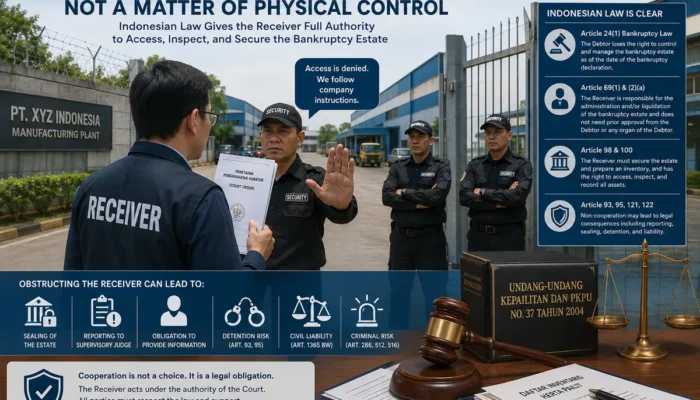
In carrying out its duties, the court-appointed Receiver visited the factory premises of the Bankrupt Debtor to inspect and record machinery, equipment, inventory, and other assets. However, the Debtor refused to provide access. The Debtor’s legal counsel also instructed security personnel to prevent the Receiver from entering the factory premises.
This incident demonstrates that, in certain cross-border investments, shareholders, directors, company controllers, and legal representatives may still have an incomplete understanding of the legal consequences of a bankruptcy declaration and the statutory authority of a Receiver under Indonesian law.
Once a company has been declared bankrupt by the Indonesian Commercial Court, factual control over the factory, keys, access systems, documents, or security personnel can no longer be used as a legal basis to prevent the Receiver from performing its duties.
1. Bankruptcy is not merely an ordinary debt dispute
Under Article 1 point 1 of Law Number 37 of 2004 concerning Bankruptcy and Suspension of Debt Payment Obligations, bankruptcy constitutes a general attachment over all assets of the Bankrupt Debtor, the administration and liquidation of which are carried out by a Receiver under the supervision of a Supervisory Judge.
Accordingly, a bankruptcy judgment does not merely determine that a Debtor has payment obligations toward its creditors. It also fundamentally changes the authority to possess, administer, and dispose of the Debtor’s assets.
Article 24 paragraph (1) of the Bankruptcy Law provides:
“By operation of law, the Debtor shall lose the right to control and manage the assets included in the bankruptcy estate as of the date on which the bankruptcy declaration is pronounced.”
Article 69 paragraph (1) further provides that the Receiver is responsible for the administration and/or liquidation of the bankruptcy estate.
Article 69 paragraph (2) letter a also confirms that, in carrying out its duties, the Receiver is not required to obtain prior approval from, or provide prior notice to, the Debtor or any organ of the Debtor, even where such approval or notice would otherwise be required outside bankruptcy proceedings.
The legal consequences are therefore as follows:
- The directors no longer have independent authority to control or manage assets forming part of the bankruptcy estate;
- Shareholders may not treat corporate assets as their personal or direct property;
- The Debtor’s legal counsel may not require the Debtor’s prior approval as a condition for the Receiver to perform its statutory functions;
- Security personnel may not rely on internal company instructions to override the Receiver’s authority under the law.
When a Receiver inspects assets, records machinery, secures documents, or traces inventory, the Receiver is not making an ordinary visit to the company’s premises. The Receiver is exercising authority conferred directly by law and by a court judgment.
2. The status of a foreign state-owned enterprise does not exclude the application of Indonesian bankruptcy law
In cross-border matters, the ultimate shareholder of an Indonesian company may be a foreign state-owned enterprise. In the matter handled by our firm, the parent company of the Debtor formed part of a corporate structure supervised by a municipal-level state-owned assets authority in China.
That status may be relevant in understanding the corporate structure, control arrangements, affiliated relationships, and possible transactions between the parent company and the Indonesian subsidiary. However, the state-owned status of the foreign shareholder does not alter the separate legal personality of the Indonesian subsidiary.
A company incorporated under Indonesian law remains subject to:
- Indonesian company law;
- Indonesian contract law, where applicable;
- Indonesian bankruptcy law;
- the jurisdiction of the Indonesian Commercial Court; and
- valid and binding judgments of Indonesian courts.
Accordingly, the state-owned background of the shareholder cannot be relied upon to:
- reject a bankruptcy judgment;
- unilaterally restrict the Receiver’s authority;
- maintain factual control over the bankruptcy estate;
- prevent inspection and recording of assets;
- transfer assets to a parent or affiliated company; or
- independently decide which assets the Receiver may or may not inspect.
On the contrary, the involvement of a state-owned enterprise should entail stricter standards of corporate governance, asset protection, managerial accountability, and compliance with the law of the country in which the investment is made.
Where, following the bankruptcy of an overseas subsidiary, there is continued refusal to hand over documents, obstruction of asset recording, unexplained affiliated transactions, or non-transparent movement of assets, the matter may no longer be confined to a commercial failure. It may develop into an issue of directors’ liability, overseas investment governance, and state-asset management.
3. Why the Receiver must be granted access to the factory
The Receiver must determine which assets form part of the bankruptcy estate, where those assets are located, their current condition, and whether they remain under the Debtor’s control or have been transferred to another party.
Article 98 of the Bankruptcy Law requires the Receiver, from the commencement of its appointment, to take all necessary measures to secure the bankruptcy estate and to take custody of letters, documents, money, jewellery, securities, and other valuable instruments against receipt.
Article 100 paragraph (1) further requires the Receiver to prepare an inventory of the bankruptcy estate no later than two days after receiving the appointment decision. Under Article 100 paragraph (3), members of the provisional creditors’ committee are entitled to attend the preparation of that inventory.
In an industrial or construction company, the Receiver’s activities at the site may include:
- Identifying land, buildings, machinery, heavy equipment, and vehicles;
- Recording serial numbers, condition, and location of machinery;
- Inspecting raw materials, work in progress, and finished goods;
- Comparing the fixed-asset register with the physical assets on site;
- Determining whether assets have been pledged, leased, transferred, or otherwise encumbered;
- Securing accounting records, contracts, invoices, warehouse records, and electronic data;
- Reviewing trade receivables and payment flows;
- Separating the Debtor’s assets from assets belonging to the parent company, affiliated companies, or third parties;
- Assessing the risk of damage, disappearance, or depreciation of assets;
- Preparing assets for valuation and sale in the liquidation process.
Without access to the site, the Receiver cannot verify whether the reported assets correspond with the actual situation. This ultimately prejudices all creditors because the value of the estate available for distribution remains uncertain.
4. Using security personnel to obstruct the Receiver is not ordinary site security
While a company is operating normally, its management may of course implement security procedures and control access by external persons. However, those internal powers cannot be used to nullify the Receiver’s authority after a bankruptcy declaration has been issued.
The conduct of security personnel may exceed ordinary security functions where they:
- close or lock gates to prevent the Receiver from entering;
- refuse to recognise the Receiver’s appointment documents;
- require approval from directors or shareholders;
- surround, push, or threaten the Receiver;
- seize documents or recording equipment;
- refuse to hand over keys, warehouse access, or asset records;
- move machinery or goods before inventorying;
- delete CCTV footage;
- obstruct bailiffs, valuers, or members of the Receiver’s team;
- conceal the location of assets.
In such circumstances, the argument that security personnel were merely following instructions does not automatically eliminate responsibility. Liability must still be assessed based on each person’s knowledge, conduct, degree of involvement, and the consequences caused.
Obstruction of access must also be distinguished from a dispute over ownership. If machinery or goods are claimed to belong to the parent company or a third party, that claim must be supported by documents and resolved through the applicable legal process. An ownership claim does not create a right to close the entire premises and prevent the Receiver from recording assets.
5. Legal counsel may raise objections but may not replace judicial process
The Debtor, shareholders, and third parties remain entitled to appoint advocates and protect their lawful interests.
Legal counsel may contend, for example, that:
- certain assets do not belong to the Debtor;
- certain goods were merely deposited by a third party;
- the scope of the Receiver’s inspection is excessive;
- trade secrets require special protection;
- certain assets are subject to security rights;
- the inventory process may interfere with ongoing operations;
- particular actions by the Receiver require approval from the Supervisory Judge.
However, such objections must be raised through the proper legal channels, including before the Receiver, the Supervisory Judge, or the Commercial Court, depending on the nature of the dispute.
A lawyer’s legal opinion does not have the same status as a court order or judgment. A lawyer cannot unilaterally declare that the Receiver lacks authority and then use security personnel to enforce that conclusion.
The distinction must be stated clearly:
Submitting an objection through legal process is the exercise of a right. Using factual force to obstruct the Receiver may constitute interference with the bankruptcy process.
Where an advocate actively directs, organises, or participates in physical obstruction of the Receiver, the conduct must be assessed on the basis of the specific acts committed, not merely on the person’s professional status as legal counsel.
6. Legal consequences within the bankruptcy proceedings
a. Sealing of the bankruptcy estate
Article 99 paragraph (1) of the Bankruptcy Law provides that the Receiver may request the Court, through the Supervisory Judge, to seal the bankruptcy estate where this is necessary to secure the estate.
Article 99 paragraph (2) provides that sealing shall be carried out by a bailiff at the place where the assets are located, in the presence of two witnesses, one of whom must be a representative of the local government.
If the Debtor refuses access or there is a risk of asset transfer, the Receiver may document that refusal and request sealing.
Accordingly, refusal to cooperate does not stop the bankruptcy process. On the contrary, it may lead to more formal and coercive intervention by the Court.
b. Reporting to the Supervisory Judge
The Receiver may report the Debtor’s lack of cooperation to the Supervisory Judge and attach evidence such as:
- notices of site visits;
- requests for the handover of documents;
- formal warnings;
- video recordings or photographs;
- incident reports;
- identities of security personnel;
- witness statements;
- vehicle access records;
- evidence of asset movement;
- evidence of deleted or concealed data.
The Supervisory Judge may use such information in supervising the administration and liquidation of the estate and in issuing directions within the scope of his or her authority.
c. Obligation of the management to provide information
Article 121 paragraph (1) of the Bankruptcy Law requires the Bankrupt Debtor to appear personally at the claims verification meeting in order to provide information requested by the Supervisory Judge concerning the causes of the bankruptcy and the condition of the bankruptcy estate.
Article 121 paragraph (2) gives creditors the right to request information from the Bankrupt Debtor through the Supervisory Judge.
Where the bankrupt party is a legal entity, Article 122 provides that this obligation rests with the management of that legal entity.
Accordingly, directors cannot fully transfer their factual disclosure obligations to legal counsel. Lawyers may provide legal assistance, but information regarding transactions, assets, accounting records, and the company’s actual condition must still be provided by the responsible management.
d. Detention of the Bankrupt Debtor
Article 93 of the Bankruptcy Law authorises the Court to order the detention of the Bankrupt Debtor, either in a state detention facility or at the Debtor’s residence under the supervision of a prosecutor appointed by the Supervisory Judge. Such an order may be issued in the bankruptcy judgment or at any time thereafter, upon the recommendation of the Supervisory Judge or at the request of the Receiver or one or more creditors.
Article 95 provides that a detention request must be granted where it is based on the Bankrupt Debtor’s intentional failure to comply with the obligations referred to in Articles 98, 110, or 121 paragraphs (1) and (2).
These provisions must be applied carefully, particularly where the Debtor is a legal entity. The identification of the person who may specifically be held responsible must take into account the person’s position, conduct, and the Court’s assessment.
Nevertheless, the provisions demonstrate that non-compliance with obligations in bankruptcy is not merely an ethical issue or a matter of poor cooperation. The Bankruptcy Law provides coercive legal consequences.
7. Potential civil liability
Obstructing the Receiver may also result in civil liability where the elements of an unlawful act under Article 1365 of the Indonesian Civil Code are satisfied.
In general, such liability requires:
- An unlawful act;
- Fault on the part of the perpetrator;
- Loss or damage;
- A causal relationship between the act and the loss.
Potential losses may include:
- damage to machinery because it could not be secured or maintained in time;
- disappearance of inventory;
- deterioration of raw materials;
- delay in valuation or sale;
- additional costs for bailiffs, security, and investigation;
- costs of data recovery;
- reduction in the value of the bankruptcy estate;
- reduced distributions to creditors;
- physical or material loss suffered by the Receiver’s team.
Liability does not necessarily end with the Debtor as a legal entity. Directors, controllers, security personnel, security service providers, or other parties may be held liable according to their respective conduct, instructions, fault, and contribution to the loss.
Similarly, an advocate is not automatically liable merely because legal assistance was provided. However, where the advocate is proven to have directly organised or participated in unlawful conduct, liability must be assessed on the basis of the specific acts committed.
8. Criminal risks under the currently applicable Indonesian Criminal Code
Law Number 1 of 2023 concerning the Indonesian Criminal Code has been in force since 2 January 2026. The Criminal Code contains several provisions relevant to bankruptcy.
Not every refusal or dispute with a Receiver automatically constitutes a criminal offence. Criminal liability must be based on the statutory elements of the offence, intent, the status of the perpetrator, and sufficient evidence.
Criminal risk may nevertheless arise in the following circumstances.
a. Failure to appear, refusal to provide information, or provision of false information
Article 286 of the Criminal Code regulates certain conduct by persons declared bankrupt, persons declared unable to pay their debts, spouses in a community-property marriage, and managers or commissioners of a civil partnership, association, or foundation declared bankrupt.
The relevant conduct includes:
- failing to appear after being lawfully summoned to provide information;
- refusing to provide requested information;
- providing false information.
The maximum penalty is imprisonment for one year and three months or a Category III fine.
The provision must be applied strictly in accordance with the categories of legal subjects expressly identified in the article. It would therefore be incorrect to state that every employee, shareholder, or legal representative may automatically be prosecuted under Article 286.
b. Fraudulent prejudice to creditors
Article 512 of the Criminal Code regulates fraudulent conduct prejudicing creditors by a business operator declared bankrupt or permitted by a court to surrender assets.
The conduct covered includes, among other matters:
- fabricating debts;
- failing to account for profits;
- withdrawing goods from the company’s assets;
- disposing of goods without consideration or at a price substantially below their value;
- preferring one creditor at the time of bankruptcy;
- failing to comply with obligations to record, preserve, and produce company books and documents.
The maximum penalty is imprisonment for seven years or a Category VI fine.
Article 513 confirms that the offences referred to in Articles 511 and 512 may also be committed by a corporation.
c. Fraudulent conduct by directors or commissioners
Article 516 of the Criminal Code regulates liability of directors or commissioners of a corporation declared bankrupt or ordered to liquidate its business, including where they:
- facilitate or permit conduct contrary to the articles of association that causes loss to the corporation;
- for the purpose of delaying bankruptcy, facilitate or permit borrowing on onerous terms despite knowing that bankruptcy cannot be prevented;
- fail to comply with record-keeping obligations or cannot produce records reflecting the true condition of the company.
The maximum penalty is imprisonment for one year and six months or a Category VI fine.
Article 517 provides that directors or commissioners of a corporation declared bankrupt who fraudulently reduce creditors’ rights through conduct referred to in Article 512 may be sentenced to imprisonment for up to seven years or a Category VI fine.
Accordingly, where obstruction of the Receiver is intended to create time for the transfer of machinery, withdrawal of goods, concealment of income, fabrication of debts, or destruction of accounting records, the issue may develop from a procedural obstruction into a suspected bankruptcy offence.
d. Violence, threats, or destruction
Where obstruction is carried out through violence, threats, seizure of documents, destruction of property, or restriction of a person’s liberty, the possible application of criminal provisions must be analysed according to the specific conduct involved.
It would not be appropriate to determine a single criminal provision merely from the fact that an “obstruction” occurred. The following matters must be established:
- who gave the instruction;
- who carried out the act;
- whether violence or threats occurred;
- whether property was damaged;
- whether documents or data were deleted or concealed;
- whether assets were moved;
- whether the Receiver produced the appointment documents;
- whether the incident was witnessed or recorded.
9. Common mistakes made by Debtors and shareholders
First mistake: treating corporate assets as the shareholder’s own property
A shareholder owns shares in the company. A shareholder does not directly own each machine, vehicle, parcel of land, item of inventory, or receivable registered in the company’s name.
Once the company is declared bankrupt, assets forming part of the bankruptcy estate fall under the administration and liquidation of the Receiver.
Second mistake: equating physical possession with legal authority
The fact that the factory remains guarded by the Debtor’s employees and security personnel does not mean that the management continues to have legal authority to refuse access to the Receiver.
Keys, fences, security guards, and access systems indicate factual control only. They do not override the legal consequences of Article 24 of the Bankruptcy Law.
Third mistake: assuming that legal remedies automatically suspend the Receiver’s duties
Article 16 paragraph (1) of the Bankruptcy Law provides that the Receiver is authorised to carry out administration and/or liquidation from the date on which the bankruptcy judgment is pronounced, even if cassation or judicial review is filed against that judgment.
Accordingly, the filing of a legal remedy does not automatically justify refusal of all actions taken by the Receiver.
Fourth mistake: treating counsel’s opinion as equivalent to a court judgment
A legal opinion may form the basis for an objection. It is not a judgment capable of cancelling or suspending the Receiver’s authority.
Fifth mistake: assuming that allowing an inventory amounts to relinquishing ownership rights
Allowing the Receiver to record assets does not mean that a third party admits that all goods at the site belong to the Debtor.
A party claiming ownership may submit:
- purchase agreements;
- invoices;
- proof of payment;
- import documents;
- lease agreements;
- handover records;
- inventory lists;
- registration documents;
- other evidence of ownership.
Ownership objections must be proven and processed through legal channels, not by closing access to the entire premises.
10. Steps creditors should take
A Debtor’s lack of cooperation is a risk indicator that creditors should not ignore. Creditors should not merely wait passively for the Receiver to act.
Measures that may be considered include:
- Requesting the Receiver to formally record every refusal;
- Providing information regarding the Debtor’s assets;
- Comparing financial statements with the assets physically present;
- Tracing transactions undertaken before the bankruptcy declaration;
- Investigating transfers of assets to affiliated companies;
- Requesting the Receiver to report the matter to the Supervisory Judge;
- Supporting an application for sealing where there is a risk of asset disappearance;
- Tracing receivables and income not reported to the Receiver;
- Reviewing transactions potentially detrimental to the bankruptcy estate;
- Considering civil or criminal action where sufficient evidence exists.
For creditors engaged in the construction sector, the review should also cover:
- who purchased the machinery and heavy equipment;
- in whose name the goods were imported;
- who paid the purchase price;
- whether the assets were recorded in the Debtor’s books;
- whether equipment belonged to a contractor;
- whether retention amounts or project payments remain outstanding;
- whether project funds were transferred to affiliated companies;
- whether assets were encumbered;
- whether receivables were due from the parent company or other affiliates;
- whether affiliated creditors’ claims require further scrutiny.
In matters involving Chinese corporate structures, documents originating from China may also be relevant, including annual reports, announcements of affiliated transactions, ownership charts, audit reports, and consolidated financial statements.
11. Compliance considerations for Indonesian subsidiaries of foreign state-owned enterprises
Where an Indonesian subsidiary of a foreign state-owned enterprise enters bankruptcy, the parent company should promptly establish a response mechanism involving its legal, finance, audit, and Indonesian legal advisory functions.
At a minimum, the company should:
- cease asset transfers lacking a lawful basis;
- secure all accounting records and electronic data;
- separate parent-company assets from subsidiary assets;
- prepare ownership evidence for third-party assets;
- provide reasonable access to the Receiver;
- review affiliated transactions before bankruptcy;
- prohibit employees from moving or concealing assets;
- submit objections through the Supervisory Judge or the Court;
- avoid using security personnel to pressure the Receiver;
- report material risks to supervisory bodies and internal auditors.
State-owned status does not provide immunity from Indonesian law. On the contrary, the involvement of state assets requires a higher standard of accountability and prudence.
Conclusion
Once a company has been declared bankrupt by the Commercial Court, the Debtor loses by operation of law the right to control and manage assets included in the bankruptcy estate. The administration and liquidation of those assets become the responsibility of the Receiver under the supervision of the Supervisory Judge.
Shareholders, directors, legal counsel, employees, and security personnel cannot use factual control over the company’s premises to nullify the Receiver’s authority.
Where disputes arise concerning ownership, the scope of inspection, confidentiality of information, or the method of inventorying, those disputes must be submitted through the appropriate legal process. Security obstruction, closure of access, and movement of assets are not substitutes for that process.
A refusal to cooperate may result in the sealing of assets, intervention by the Supervisory Judge, mandatory disclosure by the management, an application for detention under the conditions prescribed by the Bankruptcy Law, civil claims for damages, and potential criminal liability where the conduct involves fraud, false information, destruction of accounting records, or reduction of creditors’ rights.
For creditors in cross-border bankruptcy matters, legal protection does not end with filing a claim. Creditors must actively supervise asset recording, trace affiliated transactions, review cross-border corporate documents, and ensure that every act prejudicing the bankruptcy estate is properly documented and pursued through Indonesian legal procedures.
Disclaimer: This article is prepared for general legal information purposes only and does not constitute a legal opinion concerning any particular case or party. The identities of the parties and the details of the matter have been anonymised. The determination of the Receiver’s authority, ownership of assets, and the liability of each party must be based on the relevant court judgment, orders or directions of the Supervisory Judge, corporate documents, and available evidence.